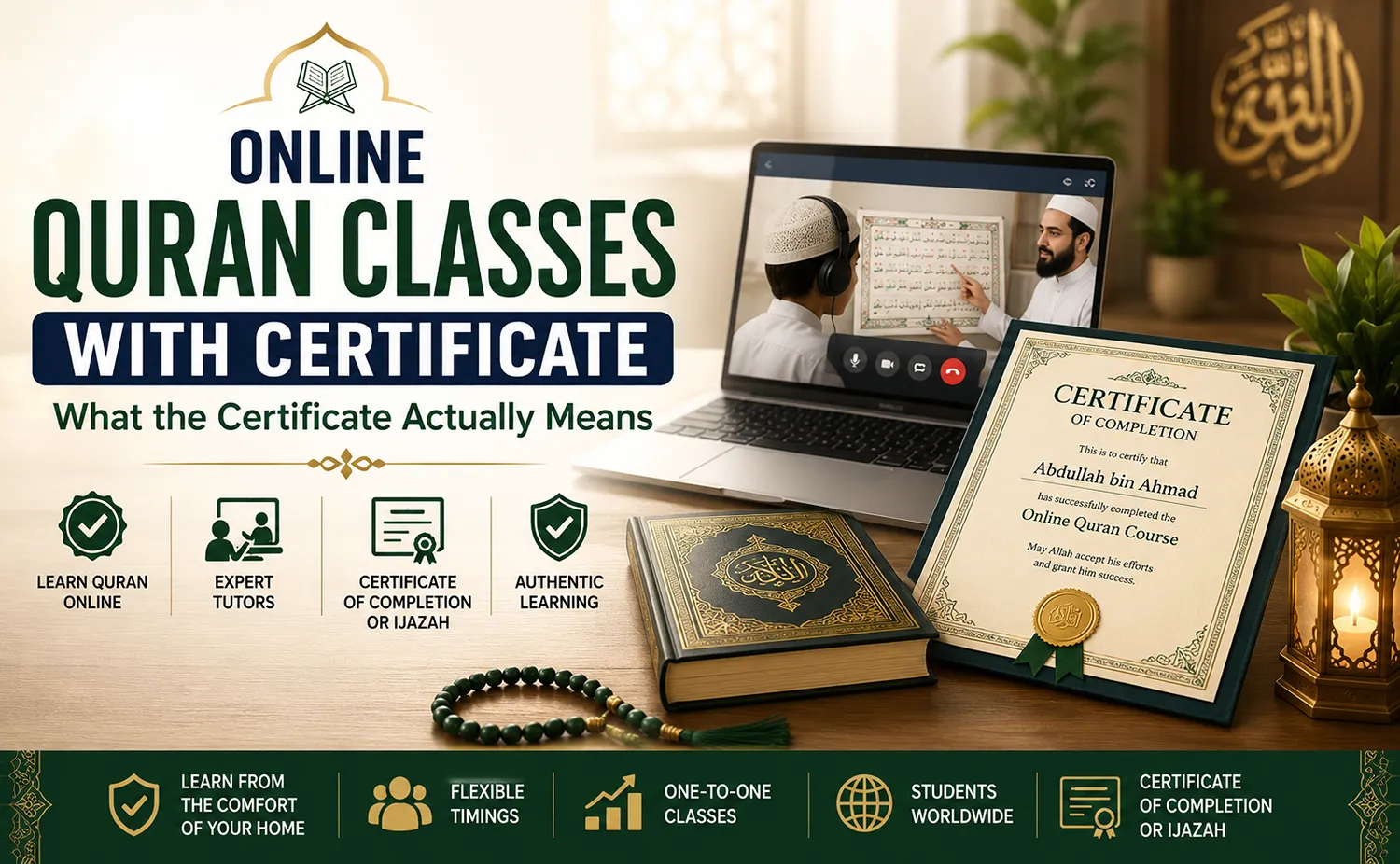
Many academies market “online Quran classes with a certificate” as though the product is the certificate. It isn’t. The certificate is merely a piece of paper (or a PDF) attesting to an event that took place during the actual classes, and the nature of that event varies greatly depending on who issued it. It’s important to know what these credentials genuinely validate, which ones are legitimate, and which ones are merely a pretty download that comes with a monthly subscription before you sign up in search of a certificate.
What Online Quran Courses with Certification
Actually Mean by “Certificate”
In this context, “certificate” refers to two very distinct things, and academies seldom specify which one they give until you inquire.
The first is a completion certificate, which certifies that you have completed a course, be it a Tajweed module, a beginner reading program, or a predetermined number of weeks with a tutor. It lacks intellectual or theological authority, yet it is helpful as a motivational milestone and a personal record. It is not regarded as a credential by anyone outside the granting academy.
The second is an Ijazah, which is a legal authorization based on centuries of Islamic intellectual tradition that attests to the fact that a trained instructor has personally confirmed your memorizing or recitation and given you permission to share that knowledge with others. When individuals talk about “getting certified” in Quran recitation, they really mean this accreditation, which functions entirely differently from a course-completion badge.
Our about us page outlines how we organize our own courses and what students may reasonably expect to leave with at each level, if you’re unsure which one a program is offering.
What is the difference between an Ijazah and a Certificate of Completion?
More than most marketing pages acknowledge, the difference between these two is important.
Based on attendance or completing a course, the academy itself issues a completion certificate. It states that “this student showed up and did the work.” An Ijazah is granted by a specific instructor based on a direct, confirmed evaluation of your recitation in accordance with Tajweed regulations. It is accompanied by a Sanad, which is a recorded line of transmission that links your teacher’s approval to previous generations of scholars. According to Harvard professor William A. Graham’s explanation of the ijazah system, it originated from the custom of going to particular scholarly authorities to personally hear their knowledge and get their permission to transmit it. This custom predates the modern classroom completely and continues to influence how Ijazah is granted today. Fandom Because of this distinction, an Ijazah, even the fastest track, typically cannot be obtained in a matter of weeks, although a completion certificate can. Attendance is measured by one. Mastery was confirmed by the other metrics.
Different Kinds of Online Quran Certification
Different skills are covered by different certificates. In general, online courses provide certification in:
Ijazah in Recitation (Qira’ah) verifies that you can correctly recite the complete Quran with proper Tajweed without necessarily having it committed to memory.
The more difficult certificate, Ijazah in Memorization (Hifz), verifies complete memorization spoken flawlessly from memory with proper Tajweed applied throughout.
Without the official Sanad-based authority that an Ijazah possesses, Tajweed completion certificates attest to your completion of a structured Tajweed course.
Certificates in reading and Noorani Qaida are entry-level completion credentials for novices who have completed basic instruction in Arabic letters and pronunciation.
Before joining somewhere, it’s wise to examine what a structured program includes if memorizing is your true objective, rather than only obtaining a certificate. The two objectives complement each other rather than vie for your time because our Quran memorizing (Hifz) curriculum is based on the kind of daily, teacher-verified revision that an eventual Ijazah track would require otherwise.
The Real Workings of the Online Ijazah Process
Academies that take it seriously appear to follow a pretty standard procedure:
evaluation. Before you start the formal track, a certified teacher assesses your existing level of memorizing or recitation.
systematic correction. As you go through the Quran section by section, the teacher corrects Tajweed and Makharij (articulation points) mistakes in real time, without using recorded feedback.
verified in stages. Instead of waiting until the end to find errors, the teacher verifies correctness as you finish parts.
Last recitation. In front of the certifying teacher, you recite the entire section—a juz, a collection of surahs, or the entire Quran, depending on the track—without making any serious mistakes.
Ijazah is granted. By recording the Sanad that links your certification to their own chain of teachers, the instructor formally approves you.
A course where you see classes and receive a certificate at the end, regardless of how well you recite, is significantly different from this. Our Tajweed workshops and Quran recitation sessions are taught one-on-one precisely because pronunciation correction doesn’t transfer well through a recorded video or a shared classroom, if real-time correction is what you’re currently lacking.
What to Look for Before Selecting an Approved Online Quran Program
Ask the following questions immediately before registering for the certificate:
Is the certificate an authentic Ijazah with a verified Sanad, or is it a completion badge? A program should be able to easily identify which of these you are receiving because they are not interchangeable.
Who is the certifying instructor, and do they possess their own Ijazah?
An authorization that they do not individually possess cannot be granted by a teacher.
Is the last evaluation unscripted, live, and one-on-one? A live recitation evaluation provides the same level of verification as a certificate based on a multiple-choice test or a recorded reading.
What is the actual duration of the program? A Hifz Ijazah that claims to be finished in a few weeks is either omitting actual verification or testing something far smaller than the entire Quran.
In addition to recitation exercises, our Quran translation course and Learn Quran in English program help you gain a deeper understanding of the context and significance of Quranic passages.
Warning Signs: When a “Certificate” Is Not Valuable
A few trends are worth keeping an eye out for. Regardless of your actual accuracy, if a program grants you a certificate after a predetermined number of weeks, that is a completion badge masquerading as an accomplishment rather than a verified skill credential. There is absolutely no way to verify the chain of permission behind your certificate if the “certifying teacher” isn’t identified or their credentials aren’t revealed. Additionally, the certificate assesses your subscription rather than your recitation if it is issued automatically after payment clears rather than following a live assessment.
All of this does not imply that completion certificates are useless; in fact, they are very helpful for monitoring development and maintaining motivation, particularly for children who are going through brief surahs from the Quran one milestone at a time. The problem only arises when a program gives you the impression that you have obtained scholarly authorization when, in reality, all you have is an attendance record.
Who Should Get an Ijazah Instead of Just a Certificate?
If you wish to someday teach the Quran yourself, lead recitation in a mosque or community context, or just want the customary, confirmed affirmation of mastery that has been a part of Islamic study for more than a millennium, then an Ijazah makes sense. It should feel like a serious, multi-month to multi-year commitment.
If your objective is to chronicle your own development, such as finishing Noorani Qaida, finishing a Tajweed course, or commemorating significant events in your child’s educational journey without the burden of a formal scholarly authorization, then a completion certificate makes more sense. Both are acceptable objectives. The misconception surrounding “online Quran classes with a certificate” actually stems from the fact that they are not the same credential.
How Much Time and Requirements Are Needed for Certification
Most structured programs require several months of regular weekly courses to earn a Tajweed or reading completion certificate. Depending on your starting level and the number of sessions you commit to each week, an Ijazah in recitation could take several months to more than a year. Even for committed students, a complete Hifz Ijazah, which encompasses the entire memorized Quran, actually requires years of continuous revision because the final exam covers the entire book with little margin for error.
It’s simpler to have a direct conversation about which track best suits your schedule and objectives than to make assumptions based on a course description. You can schedule a free trial session with a teacher who can walk you through what a realistic certification timetable looks like for where you’re starting from, or you can peruse our whole course catalog.
In conclusion
“Online Quran classes with certificate” encompasses more credentials than the term implies, ranging from a formal, centuries-old scholarly authorization to a straightforward attendance record.
They serve different purposes and neither is intrinsically superior. It’s important to understand which one is being presented to you, who is certifying it, and whether the assessment is genuine.
Before you enroll, not after, find out about the teacher’s qualifications and the evaluation procedure if you want your certificate to mean more than just a pretty PDF.
FAQ
Q1: Is an Ijazah obtained online just as legitimate as one obtained in person?
Yes, provided that it is given by a certified, qualified teacher using an actual live assessment procedure. The legitimacy of the Sanad is not affected by the format—online versus in-person—but rather by the teacher’s credentials and the assessment’s rigor.
Q2: How long does it take to obtain an online Ijazah?
While a complete Hifz Ijazah spanning the entire memorized Quran can require years of regular, daily practice, an Ijazah in recitation usually takes several months to a year for pupils with prior Tajweed mastery.
Q3: Can I teach my own children the Quran without an Ijazah?
No, official accreditation is not necessary to instruct your own children at home. If you intend to lead recitation in public, educate outside of your family, or seek the customary academic validation of your own proficiency, an Ijazah becomes pertinent.
Q4: What distinguishes an Ijazah from a certificate of completion?
A certificate of completion attests to your completion of a course or series of lessons. An Ijazah is a formal scholarly authorization that attests to the fact that a trained teacher has personally confirmed that your recitation or memorizing satisfies conventional requirements. It is supported by a documented chain of transmission (Sanad).
Q5: Is it just for advanced students to study toward an Ijazah, or may beginners?
Before enrolling in a formal Ijazah track, beginners usually begin with basic courses like Noorani Qaida and Tajweed because the certifying assessment demands accurate recitation as a beginning rather than a finish.


