
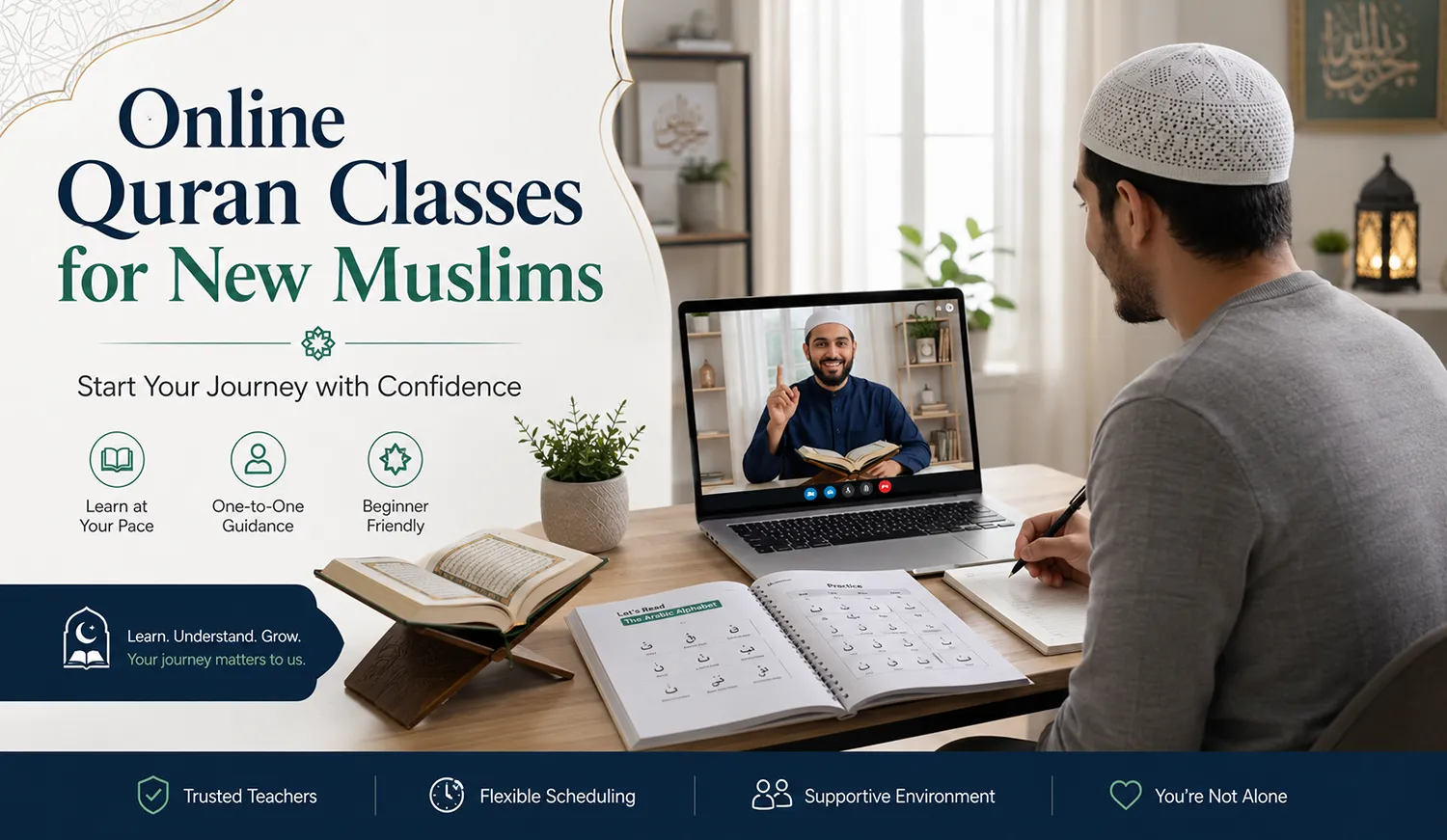
You’ve said the Shahada, or you’re on the verge of saying it, and now there’s this quiet question lurking in the back of your mind: okay, but how do I actually learn the Quran? If that’s you, take a breath. You’re not the only one asking. You’re not behind. Every year, thousands of adults across the world convert to Islam. One of the very first practical hurdles that they face is how to read Arabic writing that they’ve never seen before. And that’s precisely why online Quran classes for new Muslims exist – to take that first, slightly intimidating step and make it manageable, even enjoyable.
In this guide, we’ll walk you through what these classes really look like, what you’ll learn in your first few weeks, and how to select a program that won’t make you feel like the odd one out in a room full of people who grew up reciting Surah Al-Fatiha at age five.
Why Should New Muslims Be Taught the Qur’an Differently?
The thing is, most people don’t realize until they’re in the position: learning the Quran as a revert is a completely different experience than learning it as a child raised in a Muslim household. A child picks up Arabic sounds almost through osmosis, hearing them at home for years before he ever opens a Qaida book. For an adult convert, it’s usually from scratch, no familiarity with the alphabet, no context for the rhythm of recitation, sometimes no idea what a “surah” is beyond the word itself.
That’s not a disadvantage; that’s just a different starting point, and it requires a different way of teaching. A good Quran class for reverts will not assume any previous exposure to anything. It should also leave room for the emotional side of this journey: questions of faith, concerns about pronunciation, maybe a little anxiety about being “found out” as a newcomer. Teachers who work regularly with new Muslims tend to slow down, explain the why behind each rule instead of just the what, and normalize the fact that mistakes are part of learning, not a sign you’re doing something wrong.
And there’s also a demographic reality that’s worth knowing: the United States has one of the highest rates of religious conversion into Islam among the countries <a href=”https://www.pewresearch.org/religion/2025/03/26/religious-switching-into-and-out-of-islam/”>Pew Research Center studied in its recent global survey on religious switching</a>, with a fifth of American Muslims having been raised outside the faith. If you are a new Muslim in the US, UK, Canada, or Australia, you are not an outlier; you are part of a real and growing community.

What Will You Study in Online Quran Classes for New Muslims?
The first day of an organized beginner Quran course for adults doesn’t throw you into full recitation. It builds. Layer upon layer. Each layer supports the other.
Noorani Qaida – The First Step For Every Beginner
Every serious <a href=”https://quranjanan.com/noorani-qaida-course/”>Noorani Qaida course</a> begins here and for good reason. Noorani Qaida is basically the Arabic reading primer – it teaches you the shape and sound of each letter, how the letters join to make words, and the basic vowel signs (harakat) that tell you how to pronounce them. It’s kind of like the phonics stage before you read sentences.
This stage is more important than it seems to a new Muslim. And to bypass that and begin reciting the Quran is like trying to read a novel before you have learned your ABCs. You can do it, with enough hand-holding, but it will be slow and frustrating. Most students who do Noorani Qaida properly finish it in anywhere between two and four months of regular weekly lessons, and emerge on the other side actually able to sound out Arabic script on their own.
Tajweed and Recitation Preparation
Once the alphabet and basic reading feel comfortable, classes generally progress to short surahs and the beginnings of Tajweed, the set of rules for how each letter should be pronounced for accurate, beautiful recitation. You don’t need to learn Tajweed overnight. A <a href=”https://quranjanan.com/learn-quran-with-tajweed/”>Tajweed course</a> designed for beginners will teach rules gradually, correcting your pronunciation letter by letter instead of expecting you to be perfect from lesson one.
Recitation is one thing, but many new Muslims want to actually understand what they are reciting and not just say the words correctly. That’s where a course on <a href=”https://quranjanan.com/quran-translation/”>Quran translation and meaning</a> helps. It helps you connect the sounds you are practicing to say with the message behind them, which, for many converts, is the whole reason for beginning this journey in the first place. If Arabic still feels far away, some academies also offer sessions where the Quran is explored primarily in English, which can be a softer entry point while your Arabic reading catches up — see how a course structured around <a href=”https://quranjanan.com/learn-quran-in-english-online/”>learning Quran in English</a> strikes this balance.
And learning is not just recitation. Most new Muslims will eventually want to work towards <a href=”https://quranjanan.com/quran-memorization/”>memorizing select surahs</a> to use in daily prayer. You will need to have at least a few short chapters memorized to pray on your own.
How to Find the Best Online Quran Academy as a Revert
Not all of the academies are aimed at converts, and that is more important than people realise. Here are some things to look at before you sign up for a program:
One-on-one vs. group classes
Private lessons mean the teacher can go at your exact pace, without the feeling of being rushed by classmates who have been reading Arabic since childhood. This tends to make a real difference in confidence for someone starting from zero.
Non-judgmental environment
You want a teacher who expects you to get things wrong at first and thinks that’s totally normal, not an awkward moment to get through. Ask if the academy has experience in teaching new Muslims specifically, not just children or lifelong Muslims brushing up on skills.
Female teachers availability
If you are a woman and you want to learn from a woman, make sure that is an option before you sign up. That’s a fair preference, and it’s normal in the best academies.
Flexible schedule
Life doesn’t stop for your Quran classes, especially if you have work or family, or a partner who isn’t Muslim to juggle. Check out <a href=”https://quranjanan.com/online-quran-classes-for-adults/”>adult-focused class options</a> with evening, weekend, or timezone-friendly slots.
A truly free trial
More about a teacher’s patience and teaching style can be learned in a short trial lesson than from any amount of website copy. Use it before you buy a package.
Good prices
You shouldn’t have to decipher a confusing pricing page to know what you’re signing up for — <a href=”https://quranjanan.com/affordable-online-quran-classes/”>transparent, affordable class structures</a> are a good sign the academy values long-term students over one-time upsells.
How Quran Janan Assists New Muslim Students
With the above concerns in mind, Quran Janan has designed its beginner programs. When you start, you get your own dedicated one-on-one teacher. That way, there’s no group pace to keep up with, no pressure to perform in front of others when you’re still learning where the letters even sit in your mouth. Lessons start at Noorani Qaida and go at whatever pace is actually working for you, not a fixed calendar.
We have male and female tutors, and we can work around your time zone, whether you are in New York, London, Toronto, or Sydney. If your first priority at this point is to understand the message of the Quran in English while your Arabic develops, that’s a valid starting point too, and it’s one the curriculum accommodates rather than treats as a shortcut. And for going deeper, the same teacher can guide you through <a href=”https://quranjanan.com/courses/”>structured courses</a> on Tajweed, memorization, and Tafsir.
If you want to see how this fits into the bigger picture of who these classes serve, the overview of <a href=”https://quranjanan.com/learn-quran-online-quran-janan/”>Quran Janan’s programs for all types of learners</a> covers kids, adults and new Muslims side by side — and if you’re curious about the human side of this path, the stories of well-known public figures in the piece on <a href=”https://quranjanan.com/revert-to-islam-true-life-changes-of-world-icons/”>notable converts to Islam</a> are worth a read for perspective. Most new students begin with a <a href=”https://quranjanan.com/free-trial-online-quran-class/”>free trial class</a> before they decide to go for a complete course. You can <a href=”https://quranjanan.com/register/”>register here</a> when you are ready.
Common Questions
Can a new Muslim learn the Quran online?
Yes, and this is actually one of the most common ways new Muslims get started. Online classes let you learn in private, at your own pace, without having to travel to a mosque or feel self-conscious in a physical classroom while you are still a beginner.
Where should a new Muslim start learning the Qur’an?
Almost always with Noorani Qaida, the introductory course that teaches Arabic letters, sounds, and basic pronunciation. Before this stage, trying to recite full surahs usually ends up in frustration and mispronunciation that is harder to correct later.
Is it difficult to learn the Quran as a new Muslim?
It’s more a matter of consistency than natural ability. Most adult beginners will learn the alphabet and the stage of basic reading in two to four months of weekly lessons. The rest is much easier once that is achieved.
What is the first step for a new Muslim to learn the Quran?
Get assessed on where you are at and start with Noorani Qaida, book a trial lesson with a teacher who has experience teaching converts. Then your teacher makes a plan according to your pace and goals.
Do I have to speak Arabic before I start?
No. Courses for new Muslims target those who have not encountered the Arabic alphabet before. At the beginning, you will learn the letters and sounds. You will also practise recitation.
How much does an online Quran class for new Muslims cost?
Pricing differs from academy to academy, but many offer affordable monthly plans and a free trial class so you can see how good the teaching is before investing in a paid course.
Can women request a female Quran teacher?
Yes, most established academies, including Quran Janan, have qualified female teachers available for students who prefer that arrangement, especially for one-on-one sessions.
Summary
As a new Muslim, learning the Quran is not a race, and no one expects you to sound like a lifelong reciter in your first month. What really matters is getting off to a good start – with the right Noorani Qaida foundation, a teacher who gets you, and a pace that fits your real life outside of the classroom. Book a free trial lesson and see what it feels like to work one-on-one with a patient teacher, and let the rest build from there.


