
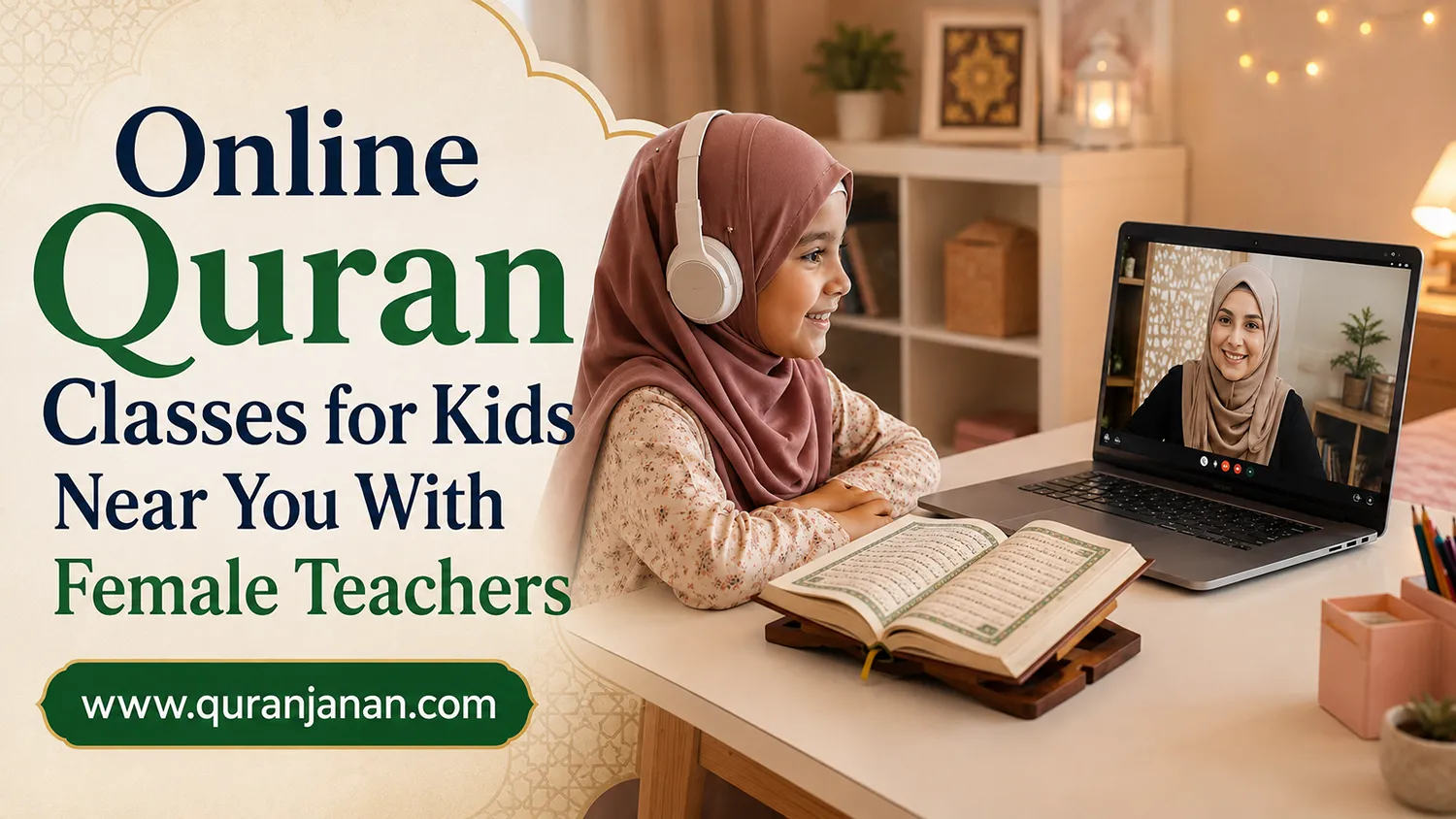
Most parents search for online Quran classes for kids near me at about the same moment: after the third week of driving across town, or after realising their child has been sitting quietly at the back of a class of eighteen and has not read aloud once. The search is really a question — where can my child get proper attention, from someone I trust, without turning our evenings upside down?
Here is the honest answer. “Near me” stopped mattering the day live one-to-one lessons became normal. What matters now is the teacher, the format, and whether your child looks forward to the class. This guide walks through how children’s online lessons actually run, why so many families request a female teacher, and what to check before you enrol.
What Parents Are Really Searching For
Nobody wants a Quran class simply because it is close. They want:
- A teacher who is patient with a six-year-old who fidgets.
- Someone qualified enough to correct pronunciation properly from the start.
- A time slot that does not collide with school, homework, or bedtime.
- The reassurance of being able to see and hear what is going on.
- A female teacher is often employed in many households, particularly for daughters.
A local madrasah delivers some of those, some of the time. Online lessons deliver all of them, and they do it in your living room. That is the whole reason online Quran classes for kids have grown so quickly among families in the USA, UK, Canada, and Australia.
Why So Many Families Ask for a Female Teacher
This comes up in almost every enquiry we get, and it is a completely reasonable request.
For daughters, especially as they get older, many parents prefer a female tutor for comfort and modesty. Mothers who want to learn alongside their children often feel far more relaxed reciting in front of a woman. And plenty of younger boys simply respond better to a gentle, teacherly manner that experienced female tutors tend to have in abundance.
There is a practical angle, too. Female tutors in our team are often the ones with the most experience teaching under-eights, because that is the age group they have specialised in for years. Warmth is not a soft skill in this job — it is the skill. A child who is not scared of making a mistake will read aloud far more, and reading aloud is how progress happens.
If this matters to your household, our dedicated online Quran classes with a female teacher cover girls, teenagers, and adult women, and you can request the same tutor every week.
How a Children’s Online Lesson Actually Runs
Forget pre-recorded videos. A real lesson is a live video call, one child and one teacher, usually twenty-five to thirty minutes.
The First Five Minutes
Salaam, a quick chat, and a look at what was set last time. Good tutors spend a minute just being friendly before any correction happens. It sounds trivial. It is the reason children stay.
The Middle
New material. For an absolute beginner, that means letter shapes and sounds from Noorani Qaida, often with the teacher sharing their screen so the child can point along. For a child who already reads, it means a few lines of a surah, read aloud, corrected letter by letter.
The teacher hears everything through the headset — clearer, in fact, than across a busy classroom. Mispronounced letters get caught immediately, before they harden into habits.
The Last Few Minutes
Recap, a small amount of practice for the week, and a note to the parent about what went well and what needs work. Some tutors end with a quick game or a sticker chart for younger children. Whatever keeps a five-year-old looking forward to Wednesday is fair.
Why One-to-One Beats a Crowded Room
Do the arithmetic. In a class of twenty children over an hour, your child gets perhaps three minutes of individual attention, and probably reads aloud twice.
In a thirty-minute one-to-one lesson, they read for twenty. Every mistake gets corrected. The pace matches your child instead of the middle of the group — faster when they are flying, slower when a letter is not clicking. This is why one-to-one online Quran classes produce noticeably faster progress for beginners, and why shy children in particular do so much better.
Group settings have their place for older, confident students revising together. For a child starting out, individual attention is not a luxury.
Tajweed From Day One, Not Later
Some parents assume Tajweed is an advanced topic to add once a child can read. It works the other way round.
Tajweed is the system governing pronunciation, elongation, and the articulation points of each Arabic letter — it has been transmitted alongside the text for centuries, as this Britannica overview of the Quran touches on. Building those sounds correctly from the first lesson is far easier than fixing them after two years of rushed reading.
A good children’s tutor teaches Tajweed without ever saying the word — by simply insisting each letter comes from the right place, gently, every time. If you want the details behind that, our guides on Tajweed rules and how to learn the Quran with Tajweed online explain the stages.

Choosing the Right Time Slot
Timing decides whether this lasts a month or five years.
Straight after school, most children are tired. Straight after dinner, many are second-wind alert. Late evening is a losing battle. Watch your own child for a week before you pick, then book that slot permanently so it becomes as automatic as brushing teeth.
For families spread across time zones — a tutor in Pakistan, a child in Ontario — insist on seeing available slots written in your local time before you commit. That single request prevents most scheduling regrets. The same principle applies to grown-ups juggling shifts, which is why our flexible online Quran classes for busy adults are built around real weekly routines.
What You Need at Home
Less than parents expect:
- A laptop, tablet, or even a phone with a working camera.
- A reasonable internet connection.
- A cheap pair of headphones, which makes more of a difference than anything else on this list.
- A quiet corner, ideally the same corner every time.
- A parent within earshot for the first few weeks.
That last point is worth taking seriously. Children whose parents occasionally sit in, ask what they learned, and listen to them recite at the weekend progress markedly faster. Our piece on the role of parents in learning the Quran covers how to help without hovering.
Keeping a Child Interested Past Month Three
Enthusiasm in week one is easy. Month three is the test.
Keep sessions short and daily rather than long and occasional — twenty focused minutes five times a week will beat two hours on a Saturday every time. Celebrate small finishes: a completed page, a surah memorised, the first time a difficult letter comes out cleanly. Let siblings learn at the same time so it feels like a household routine rather than a punishment aimed at one child.
For a structure that already works, look at the best Quran learning routine for the whole family and our notes on how to make the Quran a daily habit. If your child wants to go further, Quran memorisation for kids and our online Hifz classes add a daily memorisation and revision plan on top of reading.
Starting Young — Without Pushing
Parents often ask whether four is too early. Usually, it is not, provided the sessions are short and playful. Letter recognition, sounds, simple repetition — fifteen minutes is plenty at that age.
What causes damage is pressure. A child who associates the Quran with being told off will carry that for years. Slow and warm wins. We have written more on why kids should start learning the Quran early, including where the sweet spot tends to be.
What Safety Should Look Like
Ask directly, and expect clear answers. Tutors should be vetted. Lessons should happen on a platform where a parent can join unannounced at any point. There should be a firm rule that tutors do not contact children privately outside class time. Progress notes should come to you, the parent.
Any academy that gets uncomfortable with those questions has told you something useful.
Book a Free Trial and See for Yourself
The fastest way to judge any tutor is to watch one lesson.
At Quran Janan Online Academy, the trial is a genuine class with the teacher your child would keep — female or male, your choice — and you are welcome to sit in for the whole thing. No card details, no pressure. If it is not the right fit, tell us, and that is the end of it.
WhatsApp +92 333 2515313, email quranjanan@gmail.com, or book your free trial online Quran class and pick a slot that suits your family this week. Absolute beginners can start with our Quran lessons for beginners track, and parents who want to learn alongside their children can join Quran classes for adults online at the same time. If you are still weighing it up, the benefits of online Quran classes lay out the case in full.
Frequently Asked Questions
Are online Quran classes for kids as effective as in-person lessons?
For one-to-one learning, most families find it more effective. The tutor hears every letter clearly through a headset, your child reads aloud far more than in a group, and there is no travel time eating into the evening.
Can I request a female Quran teacher for my daughter?
Yes. Established academies employ both male and female tutors, and requesting a female teacher is a normal, common request. You should also be able to keep the same tutor each week.
At what age can my child start online Quran classes?
Many children begin around four or five with short fifteen-minute sessions focused on letter recognition and sounds. Readiness matters more than age, and shorter playful lessons work far better than long ones early on.
How long is each class, and how often should we book?
Most children’s lessons run twenty-five to thirty minutes. Four or five short sessions a week produce much better results than one long weekly class, because young learners retain more through frequent repetition.
Do I need to sit with my child during the lesson?
For the first few weeks, it helps a great deal, especially with younger children. After that, you can step back, but staying within earshot and asking what they learned keeps progress steady.
What equipment do we need at home?
A laptop, tablet, or phone with a camera, a stable internet connection, and a pair of headphones. Headphones make the biggest difference because clear audio is essential for pronunciation correction.
Is the free trial class really free?
Yes. A trial should be a full lesson with the tutor you would be assigned, with no payment details taken up front. If a trial turns into a sales call instead, treat that as a warning sign.


