
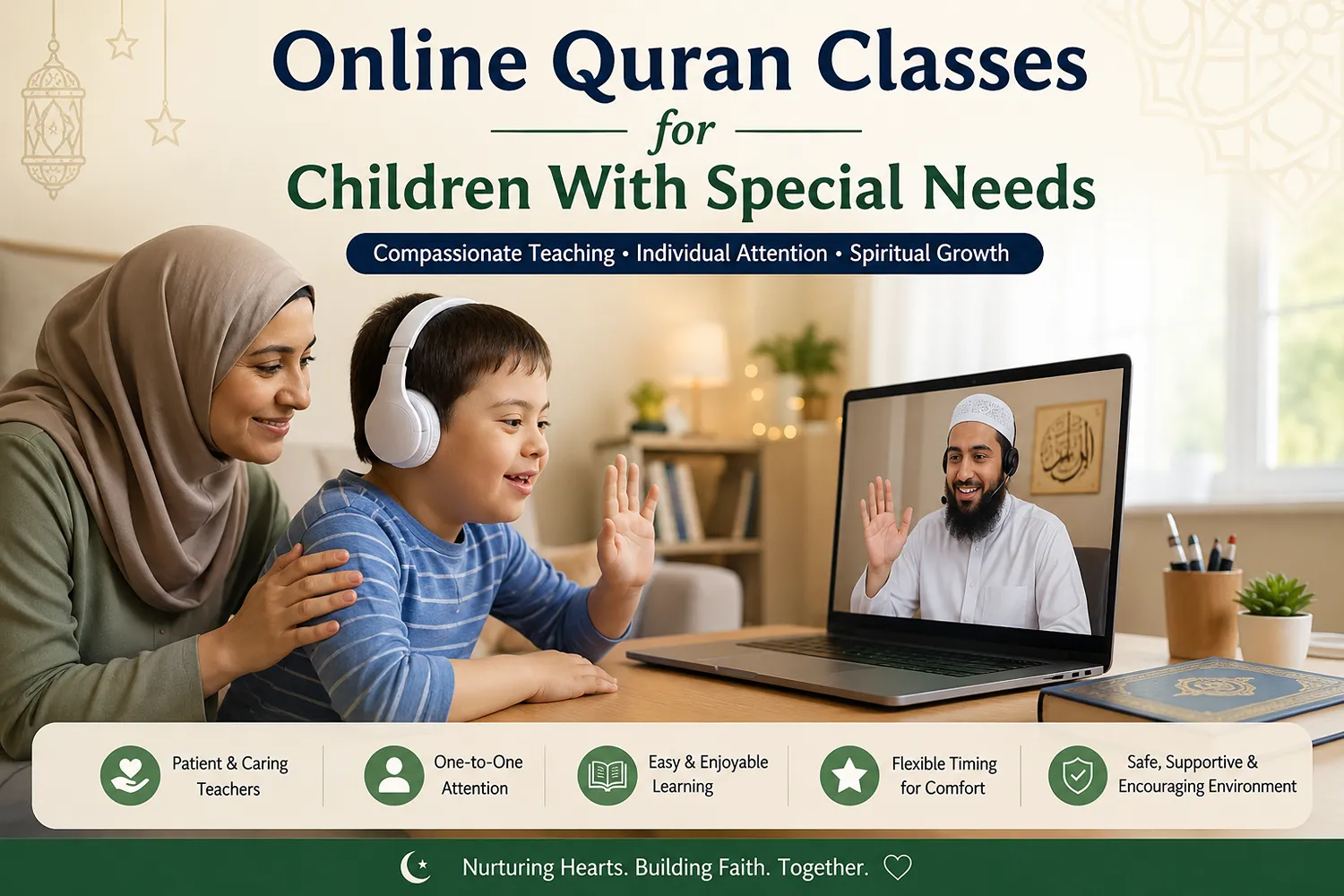
Every child deserves a connection with the Quran, and that includes children who learn differently. Parents of children with special needs often worry that ordinary classes will not have the patience, the pace, or the flexibility their child needs. That worry is fair. The good news is that one-on-one online learning is one of the most adaptable settings there is.
Online Quran classes for special needs children provide patient, one-on-one teaching that adapts to each child’s pace, learning style, and comfort, all from the security of home. A calm environment, a familiar routine, and a parent nearby make a real difference. Every child is different, so a gentle trial helps find the right teacher and approach.
Why one-on-one suits children who learn differently
The strength of private online learning is that it bends completely to one child. There is no group pace to keep up with, no crowded room to overwhelm the senses, and no fixed script the teacher must rush through. The lesson becomes whatever your child needs it to be that day.
Individualised teaching is widely recognised as central to supporting children who learn differently, a principle that runs through the field of special education, as this Encyclopaedia Britannica entry on special education describes. Our one-to-one online Quran classes and online Quran tutor service are built around this individual attention.
The comfort of learning from home
For many children with special needs, environment is everything. A new building, unfamiliar faces, and the sounds of a busy classroom can be too much before any learning begins. Home removes those barriers. Your child stays in a space they know, with the people and objects that keep them calm.
That familiarity often unlocks focus that a classroom could not reach. A parent can sit beside the child, help them settle, and step in when needed. Our guide on the role of parents in learning the Quran and our Islamic parenting tips offer gentle ways to support without pressure.
Adapting the pace and the goals
There is no single timeline, and that is the point. Some children thrive learning a few letters over many weeks. Others surprise everyone. The teacher follows the child, celebrating small wins and never forcing a pace that causes distress. Progress is measured against your child, not a class average.
Goals are set individually too. For one child, recognising and sounding a handful of letters through the Noorani Qaida method is a real achievement. For another, learning a short surah by heart is the aim. Our short surahs for kids and online Quran classes for kids can be shaped around whatever suits your child.

Simple ways lessons can be adapted
Good teachers use small adjustments that make a big difference. These are shaped to each child, but common approaches include the following.
- Shorter sessions.Ten to fifteen minutes, repeated often, to match attention and energy.
- Clear, calm pacing.Fewer new things per lesson, with plenty of gentle repetition.
- Multi-sensory cues.Large letters, colour, sound, and rhythm to support memory.
- Predictable routine.The same structure each time, which many children find reassuring.
- Frequent encouragement.Praise for effort, keeping the mood positive and safe.
The teacher works with you to learn what helps your child and what to avoid. Our tips to motivate children to learn the Quran and fun ways to teach Islam to kids add more gentle, adaptable ideas.
Working together with parents
You know your child better than anyone, and the best results come from the teacher and parent working as a team. Sharing what calms your child, what overwhelms them, and how they communicate helps the teacher tailor each session from the start rather than through trial and error.
A short conversation before the first lesson lets the teacher prepare. For daughters, or where it helps your child feel comfortable, our online Quran classes with a female teacher are available. The aim is always your child’s comfort first, learning second, knowing the two go together.
Every child’s journey is different
There is no standard path here, and comparing your child to anyone else only adds pressure that helps no one. One child may spend happy weeks on a few letters. Another may surprise everyone with a short surah. Both are real, valuable progress.
The freedom of one-on-one online learning is that the lesson follows the child, not a syllabus. A teacher can pause, repeat, change approach, or simply slow down on a hard day, all without a group waiting. That responsiveness is exactly what many children who learn differently need to feel safe enough to try. Our one-to-one online Quran classes are built around that flexibility, and our online Quran classes for kids can be shaped to each child.
What matters is the direction of travel, not the speed. A child who is calm, engaged, and slowly building a bond with the Quran is succeeding, whatever the pace.
Patience is the real method
If there is one thing that matters most here, it is patience. Progress may be slow, uneven, or come in unexpected bursts, and all of that is fine. A teacher who stays calm, warm, and unhurried gives your child the safety to try, and trying is where every bit of learning begins.
Celebrate the small steps. A new letter recognised, a calmer lesson, a moment of joy at the sounds of the Quran. These are real successes. Our overview of the benefits of online Quran classes reflects how a gentle, flexible format supports every kind of learner.
Preparing for the first lesson
A little preparation makes a first lesson calmer for a child who learns differently. The goal is to remove surprises, since predictability helps most children feel safe enough to engage.
Set up the space in advance, in a familiar spot with few distractions and the child’s comforting objects nearby. Have the device ready and tested before the start time so the opening moments are unhurried. Keep the first session short, and let your child know gently what to expect beforehand.
Share the key things with the teacher ahead of time: how your child communicates, what soothes them, what to avoid, and any signals that they are becoming overwhelmed. A short note or call before the lesson lets the teacher tailor their approach from the very first minute. Our guide on the role of parents in learning the Quran offers more on setting up a supportive start.
Celebrating progress your way
Progress for a child with special needs may not look like a report card, and it does not need to. The meaningful milestones are personal: a calmer lesson, a new letter recognised, a moment of joy at the sound of a recited verse. These deserve real celebration.
Measure against your own child, never against others, and let their pace be the only pace that matters. Small, genuine wins build the confidence that carries learning forward. Our short surahs for kids give gentle, achievable goals, and our tips to motivate children to learn the Quran keep the encouragement warm and steady.
Book a gentle, no-pressure trial
Because every child is different, the best next step is a calm trial lesson. You can be right beside your child, share what helps them, and see how a patient teacher adapts. There is no pressure to continue if the fit is not right.
Message Quran Janan Online Academy on WhatsApp at +92 333 2515313, or register through our free trial online Quran class page. Tell us about your child’s needs and what helps them feel comfortable, and we will match a patient teacher for a gentle trial.
Frequently asked questions
Can children with special needs learn the Quran online?
Yes. One-on-one online lessons adapt to each child’s pace, learning style, and comfort. Learning from home in a familiar, calm environment often helps children focus and engage more easily.
How are lessons adapted for special needs?
Teachers use shorter sessions, calm pacing, multi-sensory cues, a predictable routine, and frequent encouragement. The exact approach is shaped to your child, worked out together with you as the parent.
Should a parent be present during lessons?
Ideally, yes. A parent can help the child settle, support communication, and step in when needed. Working as a team with the teacher usually gives the best results.
What goals are realistic for my child?
Goals are set individually. For some children, recognising a few letters is a real achievement; for others, learning a short surah. Progress is measured against your child, never a class average.
Can I request a female teacher?
Yes. Female teachers are available, and choosing a teacher your child feels comfortable with can make a real difference to how settled and engaged they are.
Is there a trial before committing?
Yes. A gentle, no-pressure trial lets you sit with your child, share what helps them, and see how a patient teacher adapts before deciding whether to continue.


