
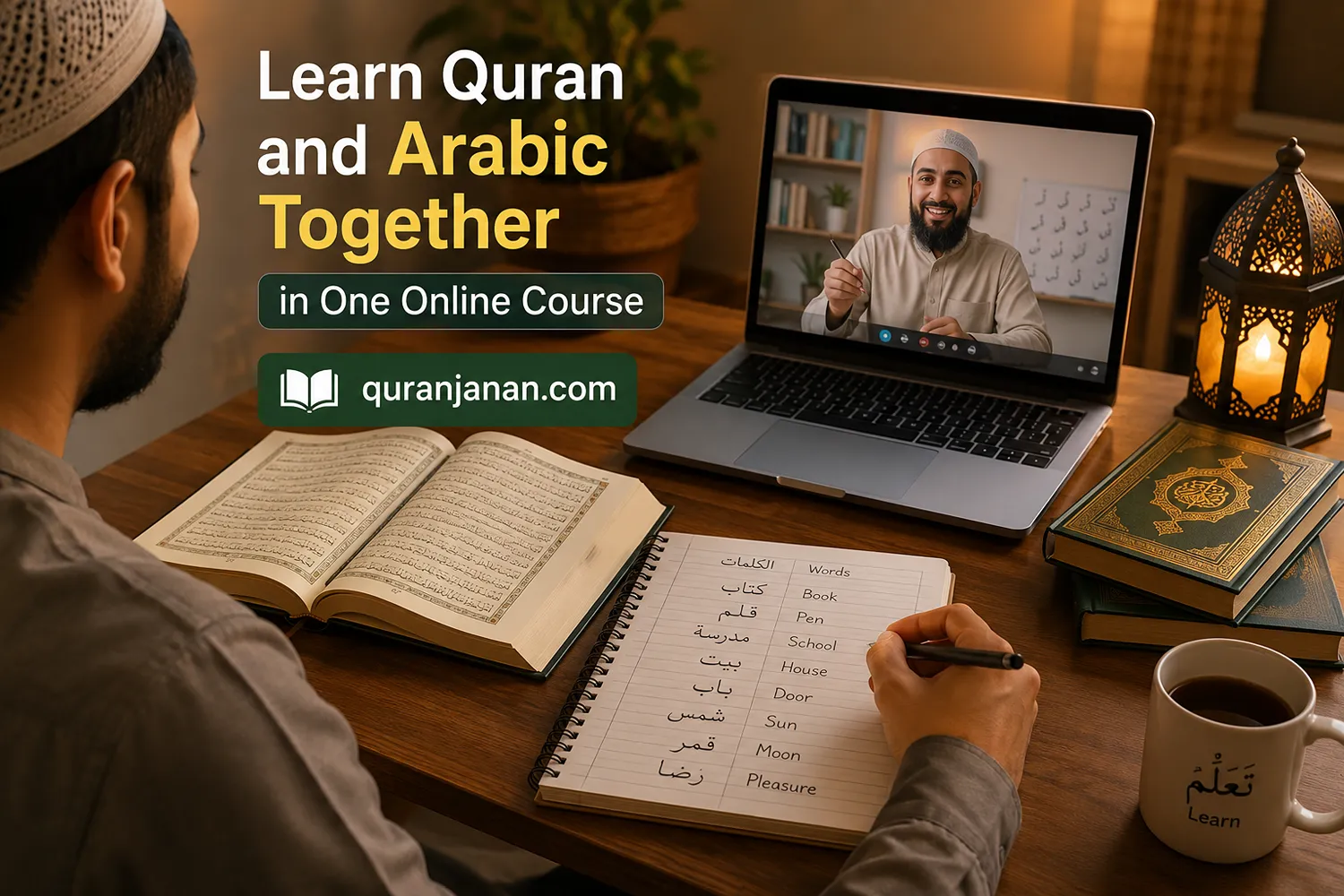
There is a moment most people who learn to recite eventually reach. The reading has become smooth, the Tajweed is holding up, the surahs are familiar — and then a thought arrives that is hard to shake. *I still don’t know what I’m saying.*
That gap is exactly what online Quran and Arabic classes are designed to close. Not classical grammar for its own sake, and not a language app that teaches you how to order coffee in Cairo, but the specific Arabic that appears in the text you already recite. Learn the two side by side and each one makes the other easier. This guide explains how that works, who it suits, and what a combined course actually looks like week to week.
Why Recitation and Understanding Are Usually Taught Apart
Traditional teaching splits them for a practical reason: reading correctly is urgent, and understanding takes longer.
So a child learns letters, then joining, then fluency, then Tajweed. Arabic comprehension gets left for “later” — and later often means never. Adults who were taught this way can recite beautifully for thirty years without recognising more than a handful of words.
There is nothing wrong with that sequence for a five-year-old. But for a teenager or an adult, splitting them is a missed opportunity. You are already handling Arabic letters every day. Attaching meaning to them costs far less effort than starting a language from scratch.
What “Quranic Arabic” Actually Means
It helps to be precise about the scope, because the phrase scares people unnecessarily.
Quranic Arabic is not the same as modern spoken Arabic. It is Classical Arabic, and the vocabulary is far more contained than you would expect. A relatively small set of root words accounts for a very large proportion of the text, because the same roots recur constantly in different forms. Arabic’s root-and-pattern structure — three consonants carrying a core meaning, reshaped into verbs and nouns by predictable patterns — is described well in this Britannica entry on the Arabic language.
That structure is the good news. Learn one root, and you unlock a family of related words at once. It is why people who study Quranic Arabic for a year often report recognising far more than they expected, far sooner than they expected.
How Learning Both Together Speeds Everything Up
Meaning Makes Memorisation Stick
Memorising sounds is hard. Memorising sentences you understand is dramatically easier, because meaning gives your brain a structure to hang the words on. Students working through Hifz memorisation alongside vocabulary study almost always retain more per week than those memorising phonetically.
Grammar Explains Pronunciation
Some Tajweed and recitation questions are really grammar questions in disguise — why a word ends the way it does, where a pause is appropriate, why two similar-looking words are read differently. Once you know a little morphology, several rules stop feeling arbitrary. Our guides on Tajweed rules and online Tajweed classes go deeper on the recitation side.
Attention Improves in Salah
This is the reason most adults actually enrol, though they rarely say it first. Recognising phrases in prayer changes the experience of praying. Once you catch even a few words in Al-Fatihah, the rest becomes something you are listening to rather than performing.
Progress Feels Visible
Reading fluency plateaus after a while — you are already fluent, so improvement gets hard to see. Vocabulary does not plateau. Every week you know more words than last week, and that visible movement keeps people going through the flat months.
Who a Combined Course Suits
Adults who already read. The single best fit. The mechanics are done; now the meaning can go in. Our Quran classes for adults online can be arranged with a language component built in.
Teenagers. Often the ideal age. Old enough for grammar, young enough that memorisation is effortless, and usually asking sharper questions than anyone expects.
Converts and reverts. Learning to read and learning meaning at the same time avoids years of reciting sounds that mean nothing yet. Starting from zero is completely normal here — the Quran lessons for beginners track begins with the Arabic alphabet and builds from there.
Parents learning with their children. Two tracks, one household, the same evening hour. Children work on reading through online Quran classes for kids while a parent studies vocabulary — and the shared routine keeps everyone honest.

What a Combined Lesson Looks Like
A typical forty-minute session with a one-to-one tutor:
- Recitation, roughly fifteen minutes. You read, the teacher corrects, and Tajweed is applied in real time rather than discussed in theory.
- Vocabulary, ten to fifteen minutes.Words from the passage you just read. Not a random list — the actual words in front of you, which is why they stick.
- A little structure, five to ten minutes.One grammar point at a time. What a pronoun suffix does. How a past-tense verb is formed. Small doses, repeated.
- Practice for the week.Usually a handful of words to review and a few lines to re-read with meaning in mind.
Nothing about that is overwhelming, and that is deliberate. The failure mode for adult learners is not difficulty — it is an ambitious plan abandoned in week five.
Why One-to-One Matters Here More Than Anywhere
Combined study is highly personal. Your vocabulary gaps are not the same as anyone else’s, and the passage you are working through is your own.
A tutor teaching you alone can pull examples straight from what you recited that morning, slow down on the one grammar point that has not landed, and skip what you already know. In a group, the material is a compromise. This is precisely where one-to-one online Quran classes justify themselves, and it is even more true once language study enters the picture.
Fitting It Around a Real Life
The honest constraint for most adults is time, not ability.
Three or four sessions of forty minutes a week is a realistic target for someone working full time. Add ten minutes of vocabulary review on the other days — on a commute, after Fajr, whenever the gap exists — and you have a workable rhythm. Trying to do ninety-minute sessions after a long day is how people quit.
Evening and weekend slots are usually the answer, which is what our flexible online Quran classes for busy adults are built around. Building the habit properly matters more than intensity, and how to make the Quran a daily habit covers the mechanics of that better than willpower ever will.
What to Expect in the First Six Months
Rough, honest expectations rather than marketing promises.
Month one to two. Recitation tightens up. You start recognising the most frequent words — the ones that appear hundreds of times. Al-Fatihah begins to open up.
Month three to four. Short surahs start making partial sense on their own. You notice patterns: the same root appearing in different shapes. Prayer feels different.
Month five to six. You can follow the general sense of familiar passages without a translation beside you. Not fluency — but a real shift, and the point at which most students stop needing to be persuaded to continue.
Push harder, and it moves faster. Consistency, not intensity, is what determines where you land.
For Families Doing This Together
Households learn better in parallel than in isolation. When everyone has a slot in the same evening hour, the routine survives busy weeks in a way that individual good intentions do not.
Younger children stick to reading and Quran memorisation for kids; older ones can start vocabulary, and adults take the combined track. The best Quran learning routine for the whole family sets out a template, and the role of parents in learning the Quran covers how much involvement actually helps.
Start With a Free Trial
The fastest way to know whether this suits you is one lesson.
At Quran Janan Online Academy, your trial is a real class with the tutor you would keep — male or female, whichever you prefer — and you can ask them to demonstrate exactly how the recitation and vocabulary halves fit together. No payment details, no obligation.
WhatsApp +92 333 2515313, email quranjanan@gmail.com, or book your free trial online Quran class and choose a time that fits your week. If you want the wider case for learning this way first, we have set it out in the benefits of online Quran classes, and you can read about working with an online Quran tutor before you commit to anything.
Frequently Asked Questions
Do I need to know Arabic before starting Quran classes?
- No. Complete beginners start with the Arabic alphabet and letter sounds, then move on to joining letters and reading. Understanding vocabulary is added gradually once basic reading is in place, or alongside it for older students.
Is Quranic Arabic the same as modern spoken Arabic?
- No. Quranic Arabic is Classical Arabic, which differs from the everyday dialects spoken across the Arab world today. Studying it will help you recognise a great deal of Modern Standard Arabic, but it will not by itself make you conversational.
How long does it take to understand what I recite?
- Most consistent students begin recognising frequently repeated words within two to three months, and can follow the general sense of familiar short surahs by around six months. Deeper comprehension continues developing for years.
Can children learn Quran and Arabic at the same time?
- Older children and teenagers usually can. Younger children generally do better focusing on reading and pronunciation first, with vocabulary introduced informally once fluency is comfortable.
How many classes a week do I need?
- Three or four sessions a week is a realistic and effective target for most adults, with short vocabulary review on the days in between. Frequency matters more than long sessions.
Are classes one-to-one or in groups?
- For combined Quran and Arabic study, one-to-one is strongly preferable. Your vocabulary gaps and the passage you are working through are specific to you, so a private tutor can tailor every lesson rather than teaching to a group average.
Can my whole family enrol on different tracks?
- Yes. Households often book adjacent slots in the same evening, so children work on reading and memorisation while a parent studies vocabulary and grammar with a separate tutor.


