
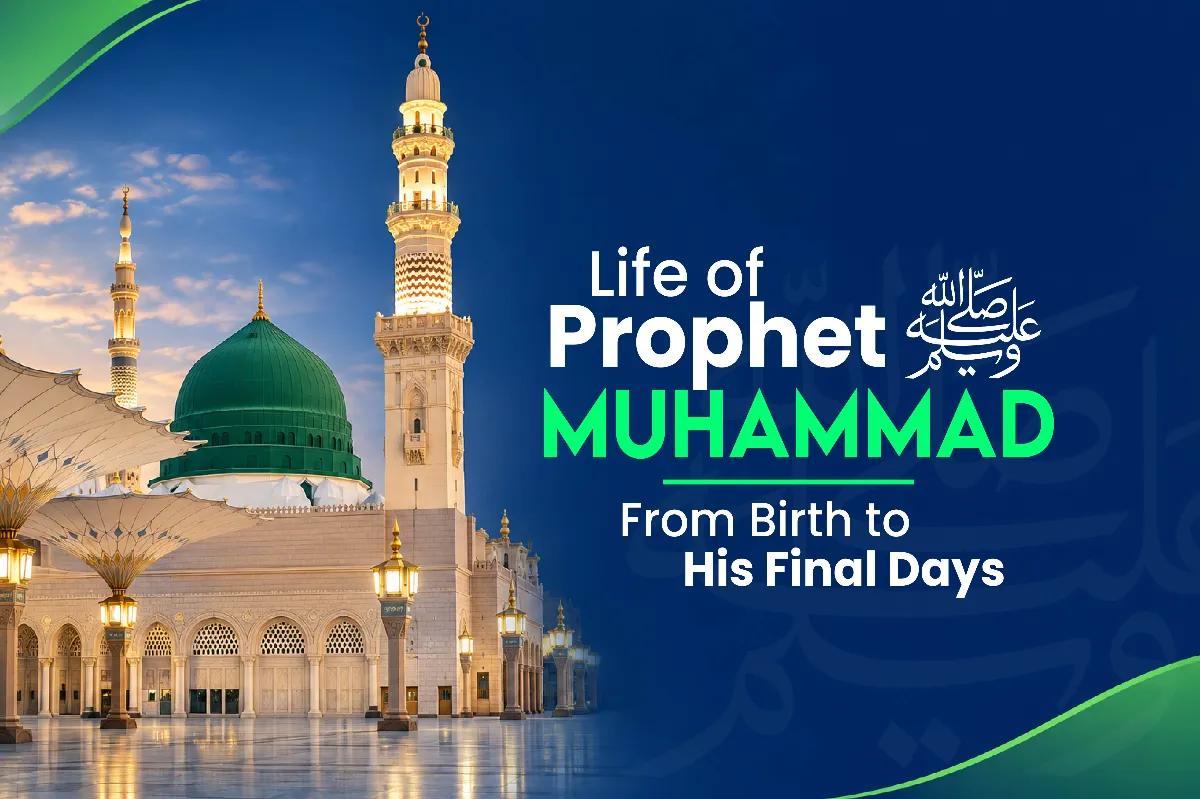
The life of Prophet Muhammad ﷺ is one of the most important stories for Muslims around the world. He was the final Messenger of Allah and the person through whom Allah delivered the final revelation, the Quran. His life shows Muslims how to live with faith, patience, honesty, mercy, courage, and good character.
The Life of Prophet Muhammad is also known as his Seerah. It covers his childhood in Makkah, his life as a trusted and respected man, the beginning of revelation, his years of calling people to Islam, the migration to Madinah, the growth of the Muslim community, the return to Makkah, and his final days.
Prophet Muhammad ﷺ faced many hardships. He lost his parents at a young age, experienced rejection from his own people, faced persecution, and lived through years of difficulty. Yet he continued his mission with patience and trust in Allah.
Learning about the Prophet Muhammad biography is not only about remembering historical events. It is about understanding how he treated people and how he responded to difficult situations. His example remains a source of guidance for Muslims today.
Birth and Early Life of Prophet Muhammad ﷺ
His Birth in Makkah
Prophet Muhammad ﷺ was born in Makkah in the Year of the Elephant, around 570 CE. He belonged to the respected Quraysh tribe and to the family of Banu Hashim.
His father was Abdullah ibn Abdul Muttalib, and his mother was Aminah bint Wahb. His father died before he was born, so Muhammad ﷺ entered the world without his father.
At that time, Makkah was an important center in Arabia. The Ka’bah was already there, but many people had turned away from the pure worship of Allah and followed different idols and practices.
His Family and Childhood
His grandfather, Abdul Muttalib, cared for him after the death of his mother. Later, his uncle Abu Talib took responsibility for him.
As a child, Muhammad ﷺ experienced loss and hardship. His mother died when he was about six years old. His grandfather then cared for him, but his grandfather also died when Muhammad ﷺ was about eight.
These early experiences shaped his character. He knew what it meant to lose loved ones and to live through difficult circumstances.
Life with Halimah Sa’diyah
Like many children in Makkah at that time, Muhammad ﷺ spent part of his early childhood with a nursing family in the desert. He was cared for by Halimah Sa’diyah.
Living in the desert gave children an opportunity to grow in a healthy environment and learn the clear Arabic language. Muhammad ﷺ spent his early years with Halimah’s family before returning to his mother.
The Loss of His Parents
When Muhammad ﷺ was around six years old, his mother Aminah died after becoming ill while returning from a journey. This was a very painful loss for a young child.
After his grandfather died, his uncle Abu Talib became his guardian. Abu Talib cared for him and supported him for many years.
These events are an important part of the Prophet Muhammad early life because they help us understand the patience and compassion that later became clear in his character.

Youth and Character Before Prophethood
His Honesty and Trustworthiness
Before receiving revelation, Muhammad ﷺ was already known for his excellent character. The people of Makkah respected him for his honesty and reliability.
They called him Al Amin, meaning the trustworthy. He was known as someone who could be trusted with people’s property and matters.
His honesty was especially important because the society around him had many social problems. He did not become trustworthy only after becoming a Prophet. His good character was visible throughout his life.
Working as a Shepherd and Trader
As a young man, Muhammad ﷺ worked as a shepherd. Later, he became involved in trade.
He traveled for business and became known as a successful and honest trader. His business dealings were based on trust rather than deception.
His experience in dealing with different people also helped prepare him for his later mission. He understood the society of Makkah and the people around him.
Marriage to Khadijah رضي الله عنها
Khadijah رضي الله عنها was a respected businesswoman in Makkah. She became aware of Muhammad’s honesty and excellent character.
She entrusted him with trade, and he managed the work successfully. They later married.
Khadijah رضي الله عنها became one of the greatest sources of support for the Prophet ﷺ. She believed in him and stood beside him during the difficult beginning of his mission.
Their marriage was built on respect, trust, and care. They had children together, including Fatimah رضي الله عنها.
The Beginning of Prophethood
The First Revelation
Prophet Muhammad ﷺ often spent time alone in the Cave of Hira, reflecting and worshipping Allah.
When he was about forty years old, the angel Jibril عليه السلام came to him with the first revelation. The first revealed verses were from Surah Al Alaq.
This was the beginning of his Prophethood and the beginning of the revelation of the Quran.
The experience was powerful and frightening. Muhammad ﷺ returned home and told Khadijah رضي الله عنها what had happened. She comforted him and supported him.
Calling People to Islam
After receiving revelation, Prophet Muhammad ﷺ began calling people to worship Allah alone.
At first, the message was shared privately with close family members and trusted people. Later, the Prophet ﷺ was commanded to proclaim the message openly.
His central message was simple and powerful: worship Allah alone, leave false gods, believe in the Hereafter, act with justice, care for the weak, and live with good character.
Early Muslims
Among the first people to accept Islam were Khadijah رضي الله عنها, Abu Bakr رضي الله عنه, Ali رضي الله عنه, and Zayd ibn Harithah رضي الله عنه.
More people gradually accepted Islam. However, the Quraysh became increasingly opposed to the message because it challenged their religious practices, social system, and authority.
The Difficult Years in Makkah
Opposition from Quraysh
The early Muslims faced insults, pressure, persecution, and other forms of hardship. Some believers were tortured because they refused to leave Islam.
The Prophet ﷺ himself was insulted and harmed. Yet he did not respond with uncontrolled anger. He continued to call people toward Allah.
His response to hardship teaches the importance of patience and trust in Allah.
The Year of Sorrow
Two people who had provided important support to the Prophet ﷺ died within a difficult period: his wife Khadijah رضي الله عنها and his uncle Abu Talib.
This period became known as the Year of Sorrow.
The death of Khadijah رضي الله عنها was especially painful because she had been his companion and supporter from the beginning of revelation. The loss of Abu Talib also removed an important source of protection.
Ta’if and Its Difficulties
The Prophet ﷺ traveled to Ta’if hoping that its people would listen to his message. Instead, he faced rejection and serious mistreatment.
Despite this, he did not simply ask for their destruction. His response showed mercy and hope.
This event is an important example of the Prophet’s patience. Even when people rejected him, he continued to hope that they might one day accept guidance.
The Night Journey and Ascension
Another major event in the life of the Prophet ﷺ was Al Isra wal Mi’raj, the Night Journey and Ascension.
According to Islamic teachings, Allah took Prophet Muhammad ﷺ on a miraculous journey from Masjid al Haram to Masjid al Aqsa and then through the heavens.
The five daily prayers became an important part of Muslim worship during this event.
Hijrah to Madinah
The Migration from Makkah
As opposition in Makkah continued, the Prophet ﷺ and his companions were given permission to migrate to Madinah, which was then known as Yathrib.
The migration, known as Hijrah, was a major turning point in Islamic history.
Prophet Muhammad ﷺ migrated with Abu Bakr رضي الله عنه. They took careful steps to travel safely and eventually reached Madinah.
The Islamic calendar later began from the year of the Hijrah.
Building a New Muslim Community
In Madinah, the Prophet ﷺ established a community based on faith, cooperation, justice, and responsibility.
He helped create brotherhood between the Muhajirun, who had migrated from Makkah, and the Ansar, the Muslims of Madinah who welcomed them.
This showed that Islam connected people through faith rather than wealth, tribe, or social status.
The Prophet’s Mosque
The Prophet ﷺ helped establish the mosque in Madinah. It became a place for prayer, learning, community matters, and guidance.
The mosque was not only a place of worship. It also became an important center for the growing Muslim community.
Major Events in Madinah
The Battle of Badr
The Battle of Badr was one of the earliest major battles between the Muslims and the Quraysh.
The Muslims were fewer in number, but they relied on Allah and remained organized and patient. The Muslim victory at Badr became a major event in Islamic history.
The Battle of Uhud
The Battle of Uhud was another important event. The Muslims faced a difficult situation, and the battle taught lessons about obedience, discipline, patience, and the consequences of ignoring instructions.
The Prophet ﷺ also showed great concern for his companions during the battle.
The Battle of the Trench
When several groups prepared to attack Madinah, the Muslims used a defensive strategy by digging a trench around vulnerable areas of the city.
The idea was suggested by Salman Al Farisi رضي الله عنه.
The Battle of the Trench demonstrated planning, teamwork, patience, and trust in Allah.
The Treaty of Hudaybiyyah
The Treaty of Hudaybiyyah was an important agreement between the Muslims and Quraysh.
Although some companions initially found its terms difficult, the treaty created a period of peace that allowed people to meet and learn about Islam without the same level of conflict.
It became an important step toward the wider spread of Islam.
The Conquest of Makkah
Return to Makkah
After years of separation, Prophet Muhammad ﷺ and the Muslims returned to Makkah.
The Conquest of Makkah was a major moment in the Life of Prophet Muhammad.
Many people expected revenge because of the persecution the Muslims had suffered. Instead, the Prophet ﷺ showed remarkable mercy.
Mercy and Forgiveness
The Prophet ﷺ did not use victory as an opportunity for personal revenge. Many people who had opposed him were forgiven.
The idols around the Ka’bah were removed, and the Ka’bah was restored to the worship of Allah alone.
The conquest showed that true strength can be combined with mercy and forgiveness.
The Final Years and Farewell Pilgrimage
The Farewell Pilgrimage
In the final year of his life, Prophet Muhammad ﷺ performed the Hajj.
Large numbers of Muslims gathered with him. During this pilgrimage, he gave important guidance about faith, human dignity, rights, justice, family responsibilities, and brotherhood.
The Farewell Sermon
The Farewell Sermon is one of the most remembered parts of the Prophet Muhammad life story.
The Prophet ﷺ reminded people to worship Allah, treat others fairly, and respect people’s rights.
He emphasized that people should not be divided by race, tribe, wealth, or social position. What matters before Allah is righteousness and obedience.
His final public guidance reflected the central values he had taught throughout his mission.
His Final Days
After the Farewell Pilgrimage, Prophet Muhammad ﷺ returned to Madinah.
He became ill and his condition gradually became more serious. During his final days, he continued to care about the Muslim community and encouraged them to remain committed to prayer and faith.
He also appointed Abu Bakr رضي الله عنه to lead the prayer when he was unable to do so himself.
The Passing of Prophet Muhammad ﷺ
Prophet Muhammad ﷺ passed away in Madinah in 632 CE at the age of about sixty three.
He was buried in the room of Aishah رضي الله عنها, which is now within the Prophet’s Mosque in Madinah.
His death was a deeply painful moment for the companions. Umar رضي الله عنه was overcome by grief, while Abu Bakr رضي الله عنه reminded the people that Muhammad ﷺ was Allah’s Messenger and that Allah alone is everlasting.
The passing of the Prophet ﷺ did not end his message. The Quran had been conveyed, his teachings had been preserved, and his companions continued to spread Islam.
Important Lessons from His Life
The Seerah of Prophet Muhammad gives Muslims many practical lessons.
Patience During Hardship
The Prophet ﷺ experienced loss, rejection, persecution, and war. Yet he remained patient and trusted Allah.
Honesty
His reputation as Al Amin shows the importance of being truthful and trustworthy in daily life.
Mercy
He showed mercy to family, companions, children, neighbors, and even many people who had harmed him.
Forgiveness
The Conquest of Makkah gives a powerful example of forgiveness after victory.
Humility
Although he became the leader of a growing community, he lived simply and remained humble.
Caring for Others
The Prophet ﷺ encouraged Muslims to care for orphans, the poor, neighbors, travelers, families, and people in need.
Strong Faith
His life teaches Muslims to keep their relationship with Allah strong during both easy and difficult times.
Good Character
The Prophet ﷺ taught that good character is an essential part of faith. His behavior showed kindness, patience, justice, honesty, and humility.
Conclusion
The Life of Prophet Muhammad ﷺ is a story of faith, patience, mercy, courage, and service to humanity. From his birth in Makkah to his final days in Madinah, every stage of his life contains lessons for Muslims.
He experienced the loss of his parents, worked as a shepherd and trader, became known as Al Amin, received the first revelation at the age of forty, called people toward Islam, faced years of opposition, migrated to Madinah, built a strong Muslim community, returned to Makkah, and completed his mission.
His life was not free from hardship. Instead, his greatness can be seen in the way he responded to hardship. He remained patient when people rejected him, forgiving when he had power, humble when he became a leader, and devoted to Allah throughout his life.
For Muslims, studying the Prophet Muhammad biography is not only an academic exercise. It is a way to understand the example of the final Messenger and learn how to bring his teachings into daily life.
The best way to benefit from his Seerah is to study it with respect and then apply its lessons. We can practice honesty in our work, patience during difficulties, kindness toward our families, mercy toward others, forgiveness when possible, and regular worship of Allah.
May Allah help us learn from the life of Prophet Muhammad ﷺ and follow his example with sincerity.
Frequently Asked Questions
1. Who was Prophet Muhammad ﷺ?
Prophet Muhammad ﷺ was the final Messenger of Allah and the Prophet through whom the Quran was revealed. He called people to worship Allah alone and taught them how to live according to Islam.
2. Where was Prophet Muhammad ﷺ born?
Prophet Muhammad ﷺ was born in Makkah, in the Arabian Peninsula, around 570 CE.
3. When did Prophet Muhammad ﷺ receive his first revelation?
Prophet Muhammad ﷺ received his first revelation when he was about forty years old while he was in the Cave of Hira near Makkah.
4. Who was the first person to accept Islam?
Khadijah رضي الله عنها was the first person to believe in and accept the Prophet’s message. She strongly supported him during the early years of his mission.
5. What was Prophet Muhammad ﷺ called before Prophethood?
The people of Makkah called him Al Amin, meaning the trustworthy. He was known for honesty and reliable character.
6. Why did Prophet Muhammad ﷺ migrate to Madinah?
The Muslims faced severe opposition and persecution in Makkah. Allah allowed the Prophet ﷺ and the believers to migrate to Madinah, where they could establish a Muslim community and practice their faith more safely.
7. What is the Hijrah of Prophet Muhammad ﷺ?
Hijrah refers to the migration of Prophet Muhammad ﷺ and his companions from Makkah to Madinah. It was a major turning point in Islamic history.
8. What happened during the Conquest of Makkah?
The Muslims entered Makkah under the leadership of Prophet Muhammad ﷺ. Instead of taking revenge on his former enemies, he showed great mercy and forgiveness. The Ka’bah was restored to the worship of Allah alone.
9. When did Prophet Muhammad ﷺ pass away?
Prophet Muhammad ﷺ passed away in Madinah in 632 CE at the age of about sixty three.
10. What are the main lessons from the life of Prophet Muhammad ﷺ?
Important lessons include patience, honesty, mercy, forgiveness, humility, justice, strong faith, good character, and caring for other people.


