
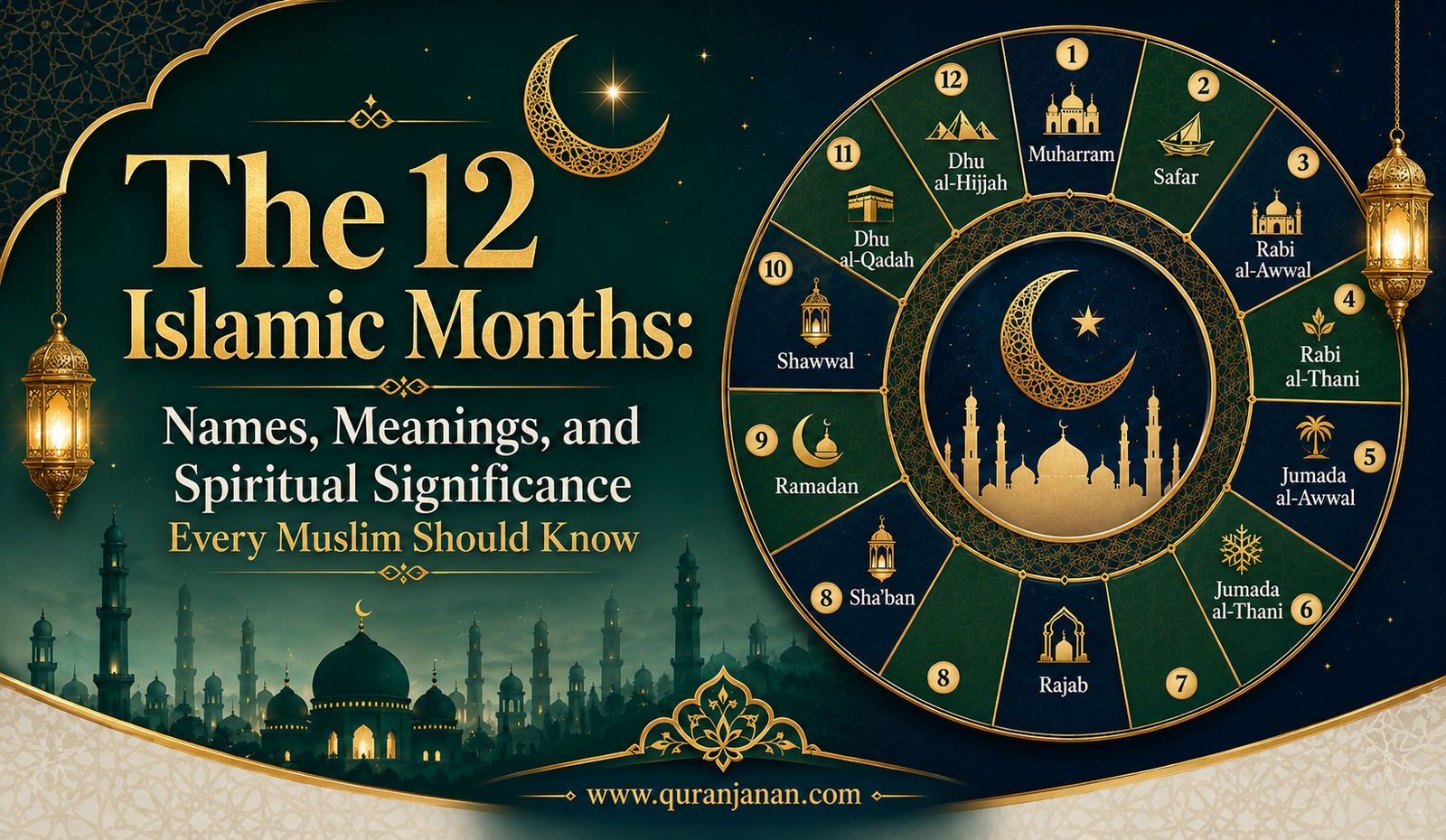
Most Muslims can recite Ramadan and Dhul Hijjah without thinking twice, but the rest of the Islamic calendar tends to blur together: Rabi al-Awwal, Jumada al-Thani, Shawwal, and Dhul Qadah. If you’ve ever found yourself nodding along in a khutbah without quite placing which month is which, you’re not alone. This guide walks through all 12 months of the Hijri calendar, what their names actually mean, which ones carry special weight in Islam, and why the whole system runs differently from the calendar hanging on your kitchen wall.
What Is the Islamic Calendar and How Does It Work?
The Islamic calendar, known as the Hijri calendar, is a purely lunar calendar; each month begins with the sighting of a new crescent moon and lasts either 29 or 30 days. That gives a Hijri year roughly 354 or 355 days, about 10 to 11 days shorter than the 365-day Gregorian solar year most of the world uses.
This is why Ramadan doesn’t fall on the same Gregorian date every year; it drifts backwards by about 10 days annually, slowly moving through every season over a 33-year cycle. A Muslim born in a summer Ramadan will, decades later, experience Ramadan in winter and eventually summer again.
The Hijri calendar takes its name from the Hijra, the migration of Prophet Muhammad ﷺ from Makkah to Madinah in 622 CE, which marks Year 1 of the Islamic calendar (1 AH, or “After Hijra”). It wasn’t formally adopted as a dating system until the time of Caliph Umar ibn al-Khattab (RA), who established it to bring order to record-keeping across the growing Muslim community.
Unlike the Gregorian calendar, which is largely a civil and administrative system, the Hijri calendar governs core acts of worship; the timing of Ramadan’s fasting, Hajj, Zakat calculations, and the two Eids all follow the lunar months, not the solar ones.
This lunar structure also means that Islamic dates shift by roughly 10-11 days earlier every Gregorian year. A child who experiences their first Ramadan fast during long summer days will, by the time they’re in their twenties, be fasting through short winter ones and eventually cycle back to summer again. Many Muslims find this rotation meaningful in its own right: no single season “owns” Ramadan or Hajj, so believers across the globe experience the physical challenge of fasting or pilgrimage differently depending on where the lunar cycle happens to fall in a given decade.
Names of All the 12 Islamic Months with Arabic Meaning
Each Hijri month has a name rooted in old Arabian tradition, often describing a season, an activity, or a state that was tied to that time of year centuries ago, even though, because the calendar is lunar, those original seasonal meanings no longer match up with fixed times of year.
- Muharram (مُحَرَّم) “The Forbidden”. One of the four sacred months, named for the prohibition of fighting during this time in pre-Islamic Arabia.
- Safar (صَفَر) “Empty” or “Void,” referring to homes left empty as people travelled or went to war in early Arabian history.
- Rabi al-Awwal (رَبِيع الأوَّل) “The First Spring,” and the month in which Prophet Muhammad ﷺ was born.
- Rabi al-Thani (رَبِيع الثَّانِي) “The Second Spring,” also called Rabi al-Akhir.
- Jumada al-Awwal (جُمَادَى الأولى) “The First Month of Dryness,” from a time when this period aligned with dry land.
- Jumada al-Thani (جُمَادَى الآخِرَة) “The Second Month of Dryness,” also called Jumada al-Akhirah.
- Rajab (رَجَب) “To Respect” or “To Honor,” another of the four sacred months.
- Sha’ban (شَعْبَان) “To Spread” or “Branch Out,” traditionally, when Arab tribes dispersed to find water. It immediately precedes Ramadan and is a month of preparation.
- Ramadan (رَمَضَان) “Scorching Heat,” the month of obligatory fasting and the revelation of the Quran.
- Shawwal (شَوَّال) “To Lift” or “Carry,” marking the start of Eid al-Fitr and the end of the Ramadan fast.
- Dhul Qadah (ذُو القَعْدَة) — “The Month of Sitting,” a sacred month traditionally associated with rest from warfare.
- Dhul Hijjah (ذُو الحِجَّة) “The Month of Pilgrimage,” when Hajj takes place, and Eid al-Adha is celebrated.
The Four Sacred Months in Islam
Four of these twelve months hold a special, elevated status: Dhul Qadah, Dhul Hijjah, Muharram, and Rajab. The Quran refers to them directly: “Indeed, the number of months with Allah is twelve [lunar] months in the register of Allah [from] the day He created the heavens and the earth; of these, four are sacred” (Surah At-Tawbah, 9:36).
Historically, warfare was prohibited during these four months, giving travellers, traders, and pilgrims safe passage across Arabia. Beyond the historical truce, scholars have long taught that sins carry greater weight and good deeds carry greater reward during these sacred months, a reason many Muslims increase their worship, charity, and self-restraint specifically during Muharram and Rajab, alongside the widely observed devotion of Dhul Hijjah.
Most Spiritually Important Islamic Months and Their Virtues
While every month carries its own blessings, a handful stand out for the acts of worship tied specifically to them.
Muharram opens the Islamic year and includes the Day of Ashura (the 10th of Muharram), a day the Prophet ﷺ himself fasted and encouraged others to fast, commemorating Allah’s rescue of Prophet Musa (AS) from Pharaoh. It’s also a month of reflection, given its historical association with the tragic events at Karbala.
Rajab marks the beginning of a spiritual build-up toward Ramadan. It’s associated with Isra and Mi’raj, the Prophet’s ﷺ night journey and ascension, and many Muslims use it to begin increasing voluntary worship ahead of Sha’ban and Ramadan.
Ramadan needs little introduction: the month of obligatory fasting, heightened Quran recitation, and the Night of Decree (Laylatul Qadr), described in the Quran as “better than a thousand months”. It’s widely regarded as the most spiritually significant month in the entire calendar.
Dhul Hijjah, particularly its first ten days, holds a status the Prophet ﷺ described as more beloved to Allah than deeds done in any other days of the year. It includes the Day of Arafah, the peak of Hajj, and culminates in Eid al-Adha, the Festival of Sacrifice. Many families use this time to revisit the Sunnah practices tied to the occasion, from the Qurbani sacrifice to the Takbeer recited across the ten days; if you want a fuller breakdown of what to actually do on the day itself, this guide on Sunnahs to follow on Eid al-Adha covers it step by step.
A few other months carry meaningful, if quieter, significance too. Rabi al-Awwal is widely associated with the birth of the Prophet Muhammad ﷺ, and many Muslims mark it with increased Salawat and study of the Seerah. Shawwal, immediately after Ramadan, carries the recommended six days of voluntary fasting that many scholars say, combined with Ramadan, carries the reward of fasting an entire year. Sha’ban, often overlooked, is the month the Prophet ﷺ was known to fast most frequently outside of Ramadan, treating it as quiet preparation rather than a month to coast through.
How to Make the Most of Every Islamic Month
You don’t need to wait for Ramadan or Dhul Hijjah to make a month count. A few practical habits help many Muslims stay spiritually engaged across the whole Hijri year:
- Track the Hijri calendar alongside the Gregorian one. A simple lunar calendar app or wall chart makes it far easier to notice when a sacred month or virtuous date is approaching, rather than realising it’s already passed.
- Fast on the recommended voluntary days. Many Muslims fast Ashura in Muharram, the White Days (13th/15th of each lunar month), and the first nine days of Dhul Hijjah.
- Increase Quran recitation during Rajab and Sha’ban as a gentle build-up toward the heavier worship of Ramadan, rather than starting cold.
- Use each month’s history as a teaching moment for children; the meaning behind a name like “Ramadan” or “Dhul Hijjah” sticks far better than a date on a calendar.
- Revisit daily duas and short Surahs regularly, not just during Ramadan; consistency across the year matters more than intensity in a single month. A good place to start is understanding what dua actually means in Islam and building it into a daily habit.
Understanding the calendar is also a natural entry point into deeper Quran study once you know why a month like Muharram or Dhul Hijjah matters, reading the verses and hadith connected to it becomes far more meaningful than memorising dates alone. If you’re looking to build that foundation properly, exploring Islamic Studies courses is a natural next step, alongside general Quran learning courses.
Deepen Your Islamic Knowledge: Join Our Islamic Studies Course
Why the Calendar Matters Beyond Dates
It’s easy to treat the Hijri calendar as trivia, useful for knowing when Ramadan starts and forgettable the rest of the year. But the deeper value is in what each month represents: a reminder that time itself is meant to be used with intention, not just tracked. The Prophet ﷺ didn’t treat Rajab, Sha’ban, or the sacred months as separate from ordinary life; he used them as checkpoints, moments to reset intentions and increase good habits before they quietly slipped away.
That same idea shows up in much broader Islamic teaching about how to structure daily life around faith rather than treating worship as something confined to specific occasions. If that kind of practical, everyday approach to faith resonates with you, it’s worth reading through these Islamic life lessons for a broader look at how small, consistent habits, not just seasonal spikes in worship. tend to shape a person’s spiritual life over time.
Frequently Asked Questions
What are the 12 months of the Islamic calendar? Muharram, Safar, Rabi al-Awwal, Rabi al-Thani, Jumada al-Awwal, Jumada al-Thani, Rajab, Sha’ban, Ramadan, Shawwal, Dhul Qadah, and Dhul Hijjah each last 29 or 30 days based on the lunar cycle.
Which Islamic months are most important? Ramadan is generally regarded as the most significant due to fasting and the revelation of the Quran, followed closely by Dhul Hijjah (Hajj and Eid al-Adha), Muharram (the sacred new year and Ashura), and Rajab (Isra and Mi’raj).
What is the significance of Muharram in Islam? Muharram is one of the four sacred months and opens the Islamic year. It includes the Day of Ashura, a recommended fasting day, and carries deep historical significance, including the events of Karbala.
How does the Islamic calendar differ from the Gregorian calendar? The Islamic calendar is purely lunar, with months of 29–30 days and a year about 10–11 days shorter than the solar Gregorian calendar, causing Islamic dates like Ramadan to shift earlier each year relative to the Gregorian calendar.
Why do Islamic months start with the moon sighting rather than a fixed date? Islamic months are tied directly to the lunar cycle, and traditionally begin when the new crescent moon is physically sighted, rather than through a fixed mathematical calculation, though some communities today do use astronomical calculations for convenience.
Conclusion
The Islamic calendar isn’t just a different way of counting days; it’s a rhythm that shapes when Muslims fast, give charity, perform Hajj, and mark their most sacred occasions. Knowing the names and meaning behind each of the 12 months turns a list of unfamiliar Arabic words into something far more personal: a yearly cycle worth paying attention to, not just during Ramadan or Eid, but throughout every month in between.


