
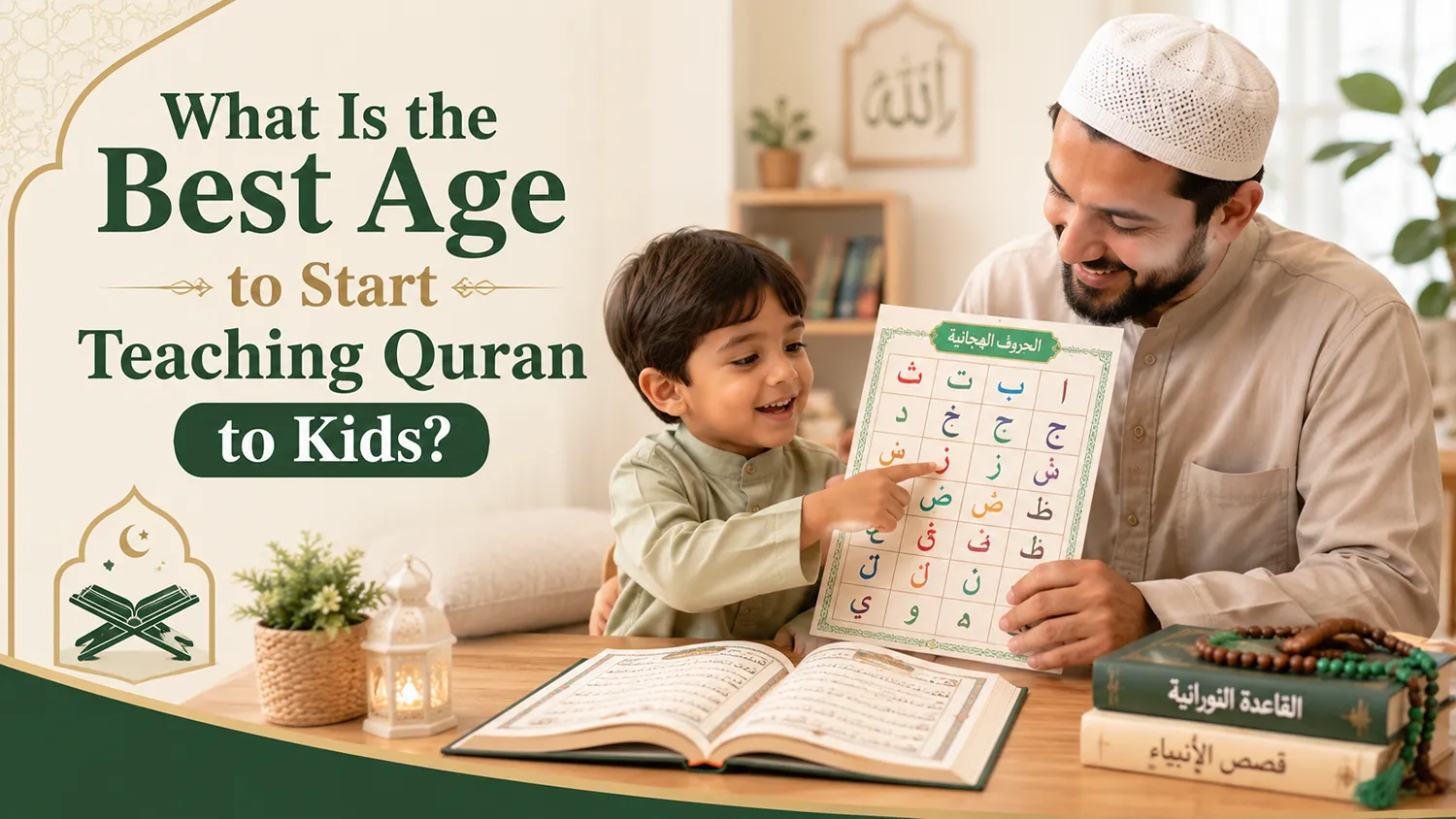
Every parent asks this at some point. Start too early, and you worry the child is not ready. Wait too long, and you worry you have missed the best window. The good news is that there is no single deadline you can miss, and the answer is more flexible than most parents fear. What matters is matching the start to your child, not to a fixed number on a chart.
The best age to start Quran for kids is generally between four and seven years old, when children can focus for short periods and copy sounds easily. That said, many families begin gentle exposure as early as three, and a slightly later start is completely fine. Readiness matters more than the exact age, and a patient online teacher can begin at whatever stage suits your child.
What is the best age to start Quran for kids?
Most scholars and teachers point to the four to seven range as the sweet spot for structured learning. At this age, children can sit for a short lesson, imitate sounds accurately, and enjoy the repetition that Quran learning involves. Their memory is sharp, and their pronunciation is still flexible, which helps with correct Arabic sounds.
But the range is a guide, not a rule. Some three-year-olds are ready for playful exposure, while some six-year-olds need a little longer to settle. A child who starts at eight or nine has lost nothing important and can still learn beautifully. The aim in these early years is love for the Quran first, skill second. Our article on why kids should start learning Quran early explains the reasoning behind the early window in more depth.
Early exposure before formal lessons (ages 2 to 4)
You can introduce the Quran long before formal reading begins. For toddlers and preschoolers, exposure means hearing recitation at home, learning a few short surahs by ear, and seeing the Arabic letters as friendly shapes rather than a subject to master. There is no pressure and no testing.
This early stage is about building familiarity and warmth. A child who grows up hearing the Quran recited gently tends to approach formal lessons later with comfort instead of anxiety. These early years are also a period of rapid brain development, when young children absorb sounds and language with remarkable ease, as explained by the Harvard Center on the Developing Child. Our guide to fun ways to teach Islam to kids has practical ideas for this age.
The best age to begin structured reading (ages 4 to 7)
This is where most children start real lessons. Around four to seven, a child can begin the Arabic alphabet properly, usually through the Noorani Qaida method, and move steadily toward reading words and short verses. Lessons at this age should be short, frequent, and playful.
Keep the sessions to fifteen or twenty minutes and end while the child still has energy. Little and often beats long and draining every time. Our Quran classes for kids are paced for young attention spans, and a good Quran tutor for kids knows how to keep a five-year-old engaged without turning the lesson into a battle.
When should kids start memorizing the Quran?
Formal memorization, or Hifz, usually works best from around age six or seven, once a child can read basic Arabic and hold short passages in memory. Starting Hifz before a child reads comfortably tends to frustrate everyone, so reading fluency generally comes first.
That said, most children memorize short surahs by ear well before they can read, simply from repetition in prayer and at home. This early memorizing is wonderful and should be encouraged. Structured, page-by-page Hifz is the part that benefits from waiting until reading is secure. Our Quran memorization for kids online program starts children on a realistic daily plan, and our list of short surahs for kids is a great place to begin.

How to tell if your child is ready
Age is only half the picture. A ready child shows a few simple signs: they can sit and focus for ten to fifteen minutes, they can copy sounds you make, they can follow simple instructions, and they show some curiosity about letters or recitation. If most of these are present, your child is ready, whatever the birth certificate says.
Use this quick readiness checklist:
- Can your child sit and pay attention for at least ten minutes?
- Can they repeat sounds and short words after you fairly accurately?
- Do they follow simple two-step instructions?
- Do they show any interest in the Arabic letters, recitation, or prayer?
- Are they generally settled rather than overwhelmed by new activities?
If you answered yes to most, start gently. If not, give it a few months and try again. Pushing a child who is not ready usually backfires and sours the whole experience.
Best age by goal: a quick comparison
The right starting age shifts slightly depending on what you want your child to achieve. This table gives a simple overview.
| Goal | Best age to start | What it looks like |
| Loving exposure to the Quran | 2 to 4 | Hearing recitation, learning surahs by ear |
| Reading Arabic letters | 4 to 6 | Noorani Qaida, letter sounds, short words |
| Reading with Tajweed | 6 to 8 | Applying recitation rules to verses |
| Formal memorization (Hifz) | 6 to 8 | Daily plan once reading is fluent |
For children building toward correct recitation, our Quran Tajweed course for kids introduces the rules in a child-friendly way once reading is underway.
The parent’s role matters more than the age
Whatever age you start, your involvement is the single biggest factor in whether it sticks. Children who see their parents value the Quran, and who get gentle daily encouragement, stay consistent far longer than children left to a teacher alone. You do not need to be a scholar. You need to show up, praise effort, and keep the tone warm.
Small habits make the difference: a fixed lesson time, a little practice together, and celebrating milestones like the first surah memorized. Our guide on the role of parents in learning the Quran and our Islamic parenting tips offer practical ways to support without pressure. If motivation dips, our ideas on how to motivate children to learn the Quran can help you reset gently.
Start whenever your child is ready
There is no perfect age you can miss, only the right moment for your child. Whether that is three, five, or eight, the important thing is to begin with warmth, keep lessons short, and let progress build naturally. Online classes make this easy, because a patient teacher can start exactly where your child is and adjust the pace week by week.
To find the right fit, message Quran Janan Online Academy on WhatsApp at +92 333 2515313, or register on our website. Ask for a free trial with a teacher who specializes in young children, and see how your child responds. You can also explore our best online Quran classes for kids to compare options before you book.
Frequently asked questions
What is the best age to start Quran for kids? Most teachers recommend starting structured lessons between four and seven, when children can focus for short periods and copy sounds well. Gentle exposure can begin as early as three, and a slightly later start is completely fine.
Can I start teaching my child the Quran at age three? Yes, through gentle exposure rather than formal reading. At three, focus on hearing recitation, learning a few short surahs by ear, and getting familiar with the Arabic letters through play. Save formal lessons for when the child can sit and focus.
What age should a child start memorizing the Quran? Structured memorization usually works best from around six or seven, once the child reads basic Arabic. Before that, children naturally memorize short surahs by ear from repetition, which should be encouraged.
Is my child too old to start if they are already eight or nine? Not at all. An older child can learn beautifully and often progresses faster because they focus better. There is no age at which it becomes too late to start learning the Quran.
How do I know if my child is ready to begin? Look for the ability to focus for ten to fifteen minutes, copy sounds accurately, follow simple instructions, and show some curiosity. If most of these are present, your child is ready to start gently.
How long should a young child’s Quran lesson be? Short and frequent works best. Fifteen to twenty minutes per session, a few times a week, keeps young children engaged without overwhelming them. Ending while they still have energy makes them look forward to the next lesson.


