
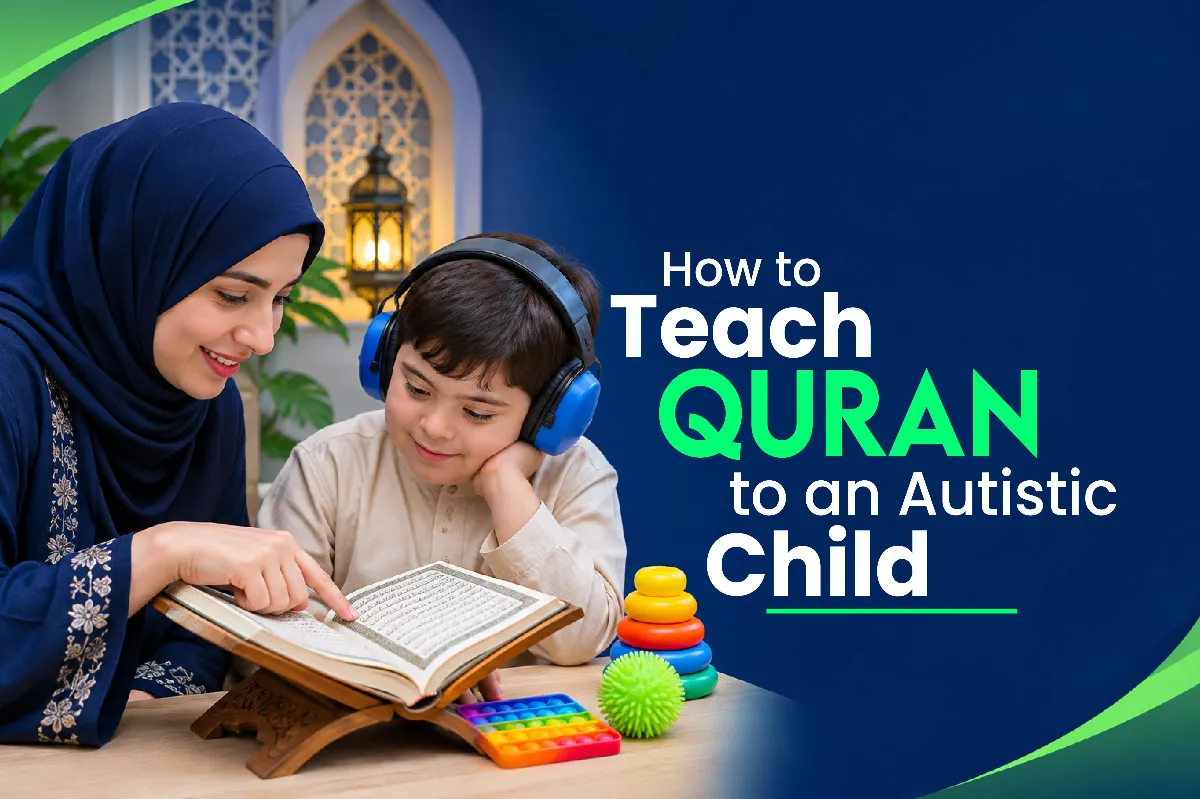
Every parent wants their child to love the Quran. Then you sit down with an autistic child, and the lesson falls apart. Your child covers his ears, walks away, or repeats one word again and again. If this sounds like your home, take a deep breath. You are not failing, and your child is not unable to learn. This guide shows you how to teach Quran to an autistic child in a calm and loving way. We will talk about how your child sees the world, what helps, and what hurts. Quran Janan wrote it to make your path lighter, one small win at a time.
Important Things to Know Before You Teach Quran to an Autistic Child
Before you open the Quran with your child, keep these points in mind.
- Autism is a spectrum. One child speaks full sentences. Another child does not speak at all. Your plan must fit your own child, not a general rule.
- Progress may look small. One new letter in one week is a real win.
- Calm comes first. A child who feels safe will learn more than a child who feels pushed.
- Love comes before skill. Your smile matters more than perfect Tajweed in the first months.
- Quran learning does not replace doctors, therapists, or school support. It works best beside them.
- Short and regular beats long and rare. Ten calm minutes every day is better than one long hour on Friday.

Benefits When You Teach Quran to an Autistic Child
Some parents ask if Quran for autistic children is worth the effort. It is, and here is why.
A calm daily rhythm: Autistic children often feel safe when life is predictable. A fixed Quran time gives your child a gentle anchor in the day.
We look at a related question in How to Find the Best Quran Teacher for Your Child Online.
A new way to connect: Many parents say the Quran became a shared space with their child. You sit side by side, you listen together, and you feel close.
Better focus and listening: Short lessons train the child to sit, listen, and finish a small task. These habits help at school and at home too.
Growth in speech and memory: Rhythm and repetition in recitation can help some children practice sounds and words. Many families notice new words after months of listening.
A sense of belonging: Your child sees family praying and reciting. When he joins even a little, he feels part of the home and the faith.
Joy and confidence: The first time your child recites a short Surah, he gets a big smile from you. That feeling stays with him for a long time.
Understanding the Child Before You Teach Quran to an Autistic Child
Many parents search for how to teach Quran to special needs child and find a long list of tips. A list is not enough, so start with your own child. Think of a lesson like a door. For some children, the door is wide open. For an autistic child, the door may be small, and it may need a special key. Your job is to find the key. Before you plan anything, watch your child for a week. When does he feel happy? What sounds upset him? Does he like pictures, music, or movement? Write down what you see. This simple habit will guide every choice you make later.
Sensory Needs When You Teach Quran to an Autistic Child
Many autistic children feel sound, light, and touch much stronger than we do. A ceiling fan may sound like a drum. A bright tube light may feel like a spotlight. A loud teacher may feel like a shout, even when the voice is normal.
So look at your room first. Choose a quiet corner. Use soft light. Switch off the television and keep phones on silent. Remove too many posters and toys from the wall behind you. Let your child sit in a seat that feels good, like a bean bag or a small chair with a cushion.
Watch for signs of stress. He may hum louder, rock, cover his ears, or turn away. These are messages, not bad behavior. When you see them, pause the lesson. Let him rest and come back later. A child who is allowed to stop will learn to trust you.
Also think about timing. Some children are fresh after Fajr. Others feel better after a snack and a short rest in the afternoon. Avoid the hours when he is tired, hungry, or just back from school.
Speech and Language Needs When You Teach Quran to an Autistic Child
Speech is different for every autistic child. Some children repeat what they hear. Some speak with a flat tone. Some need extra time to answer a simple question. A few do not use spoken words yet.
Here is what helps most. Speak slowly. Use short sentences. Give one instruction at a time. Instead of saying, “Sit down, open the book, and look at the first line,” say, “Sit.” Wait. Then say, “Open.” Wait again.
Give your child time to think. Count to ten in your head before you repeat a question. Many parents talk too soon, and the child loses his thought.
Never force eye contact. Many autistic children find it painful. Sit beside him, not in front of him. Look at the page together. This small change takes away a lot of pressure.
Non Verbal Children and How to Teach Quran to an Autistic Child
If your child does not speak, the Quran is still for him. Listening is learning. Play calm recitation by a gentle reciter and let him listen while he plays or eats. Many families see that the child begins to hum along after some weeks.
You can also use picture cards, sign language, or a tablet with speech buttons. A card with a picture of Allah’s name written in beautiful Arabic, a card for “listen,” and a card for “finished” can be enough to start. Let your child point to what he wants. When he points, praise him right away. That is communication, and it is a very big step.
Daily Life Ideas to Teach Quran to an Autistic Child
Now let us talk about how to bring the Quran into daily life. Forget the old picture of a child sitting stiff in front of a teacher for an hour. For an autistic child, learning works better when it feels like part of the day. Think of Quran time as small moments, not one long class. You can use these moments in the morning, before meals, in the car, or before bed. Each one is short, soft, and easy to repeat.
Using Sound to Teach Quran to an Autistic Child
Many autistic children learn well through hearing, especially through rhythm. The Quran has a beautiful rhythm, so this is a strong gift.
Start with listening only. Choose one short Surah, like Al Ikhlas or Al Fatiha. Play it every morning at a low volume. Do not ask your child to repeat. Just let it become a friend in the background.
After a week or two, join in softly while the audio plays. Say only the first word of each line and let your child finish it if he wants. If he does not, that is fine. Keep going.
Choose a reciter with a slow, clear voice. Fast recitation can feel like noise to a child who processes sound slowly. Many parents find that a child recitation by another young learner is more welcoming than a deep adult voice.
You can also turn lessons into small songs of repetition. Say one Ayah three times in the same tone. Children with autism often love patterns, and this pattern gives comfort.
Using Sight and Touch to Teach Quran to an Autistic Child
Many autistic children are strong visual learners. They remember what they see more than what they hear. So give the Quran a face they can see and touch.
Use color for Arabic letters. Let one letter family have one color. Many parents use soft shades instead of loud colors, so the page does not feel heavy. Use large, clear print. A Noorani Qaida with big letters is a good start for beginners.
Add a picture schedule on the wall. It can show three simple pictures: sit, listen, finish. When your child sees what comes next, he feels safe. Surprise is hard for him, and a picture schedule removes the surprise.
Bring in touch. Let him trace letters in sand, on a tray of flour, or with finger paint. Use magnetic letters on the fridge. Use wooden letters he can hold. Hands that move help the brain remember.
Use a visual timer, like a sand timer or a color bar. Your child can see how long is left. When the sand runs out, the lesson is over. This makes endings gentle and clear.
Short Surah Ideas to Teach Quran to an Autistic Child
Short Surahs are the best start for Quran memorization for autistic child learners. They are small, rhythmic, and easy to repeat. Here are some gentle ideas.
- Al Fatiha. Teach it one line at a time over weeks. Let him hear it in prayer too.
- Al Ikhlas. It is short and full of pattern. Many children love how its lines sound.
- Al Falaq and An Nas. These are good for bedtime. Make them part of the night routine.
- Al Kawthar. It is the shortest Surah. It is a good first win.
Pick only one new Ayah at a time. Review the old ones before adding anything new. Celebrate each Ayah with a smile, a hug if he likes hugs, or a small treat he enjoys. Never compare him to his cousins or classmates.
Common Mistakes When You Teach Quran to an Autistic Child
Even loving parents make mistakes when they teach Quran to an autistic child. The good news is they are easy to fix once you see them.
- Starting with long lessons. Begin with five minutes and grow slowly.
- Correcting too much. Too many corrections can break his confidence. Fix one thing at a time.
- Raising your voice. A loud voice can shut a child down. Stay soft, even when you feel tired.
- Skipping routine. Changing the time or place every day creates stress.
- Comparing him with other children. Every child has his own pace, and this is true for your child too.
- Using fear. Never use threats or fear of punishment. The Quran should feel like love.
- Ignoring your own needs. A tired parent cannot teach well. Rest, make dua, and ask family for help.
- Waiting for perfection. Mistakes in pronunciation can be corrected slowly over the years.
How Quran Janan Helps You Teach Quran to an Autistic Child
Islamic education for autistic children should always be gentle and flexible. Some families can teach at home with patience and a plan. Others want a trained teacher beside them. That is fine. You do not have to do everything alone.
Quran Janan offers Quran classes for autistic child learners who need a gentle pace. A good online Quran teacher for special needs children should listen to you first. They should ask about your child, his triggers, his strengths, and his favorite things. Then they should build a plan around him.
Here is what to look for in any teacher or academy, including Quran Janan.
- A calm, patient teacher who does not rush.
- Short lessons with a clear and simple routine.
- Willingness to use pictures, colors, and sound.
- Regular updates for parents, with honest feedback.
- Freedom to pause, break, or change the plan any time.
- Respect for your child as he is.
Online Quran classes for autistic children can work very well. Your child learns at home, in his own safe space, with his own toys and snacks nearby. You can sit in the room and learn how the teacher speaks and teaches. Then you can copy it during the week. Many parents say this made them more confident as teachers.
Summary and Conclusion on How to Teach Quran to an Autistic Child
Let us bring it all together. Learning how to teach Quran to an autistic child begins with knowing your child. Watch him. Notice what calms him and what upsets him. Make the room quiet, keep lessons short, and use sound, pictures, and touch to make the Quran easy to reach. Avoid pressure, avoid comparison, and celebrate small wins. Autism and Quran learning can go together beautifully. Remember that this is a journey of love, not a race.
You may feel tired some days. That is normal. Make dua for your child, and make dua for yourself too. Allah sees every minute you give, and He knows the love behind it. If you want a helping hand, Quran Janan is here for you and your child. Take the first small step today. Insha Allah, your child will find his own way to the words of Allah.
FAQs on How to Teach Quran to an Autistic Child
1. Can an autistic child really learn the Quran?
Yes. Many autistic children learn to listen, recite, and even memorize parts of the Quran. The speed and style may differ from other children. With patience, love, and the right method, your child can build a real bond with the Quran.
2. What is the best age to start to teach Quran to an autistic child?
There is no fixed age. You can begin with simple listening even in the early years. Formal lessons can start when your child can sit for a few minutes and show some interest. Follow his readiness, not the calendar.
3. How long should one Quran lesson be?
Start with five to ten minutes. Some children can do more, and some need less. Watch his mood and stop before he gets tired. Short and happy lessons are better than long and stressful ones.
4. What if my child does not speak?
Start with listening. Play calm recitation daily and let him hear it in prayer too. Use picture cards, signs, or speech devices so he can show what he wants. Many non verbal children grow in their own time, and the Quran stays with them as they listen.
5. Should I use a male or female teacher?
This depends on your family and your child’s comfort. Many parents choose a teacher who matches their home values and who has a soft voice. What matters most is patience, training, and kindness toward your child.
6. Are online Quran classes good for autistic children?
Yes, they can be very good. Your child stays in a familiar place and feels safe. You can sit nearby and learn from the teacher. Choose a teacher who has real experience with special needs and who is happy to adjust the plan.
7. How do I handle meltdowns during Quran time?
Stay calm and lower your voice. Stop the lesson and let your child rest in a quiet spot. Do not punish or argue. When he is calm, try again later with a shorter and easier task. Over time, a steady routine reduces meltdowns.
8. Can rewards help my child learn?
Yes, small rewards can help. Choose something your child really likes, such as a sticker, a favorite snack, or extra play time. Give the reward right after the effort, and praise him with warm words. Slowly shift the focus from rewards to the joy of reciting.
9. Is Quran memorization possible for an autistic child?
Yes. Many autistic children have strong memory and love patterns, which helps with Quran memorization. Start with short Surahs. Repeat daily and review often. Go slowly and never compare his pace with another child.
10. How can Quran Janan help my family?
Quran Janan offers gentle and patient Quran classes for autistic children. The teacher listens to the parents first and builds a plan around the child. Lessons stay short, calm, and flexible, so the child feels safe and loved.


