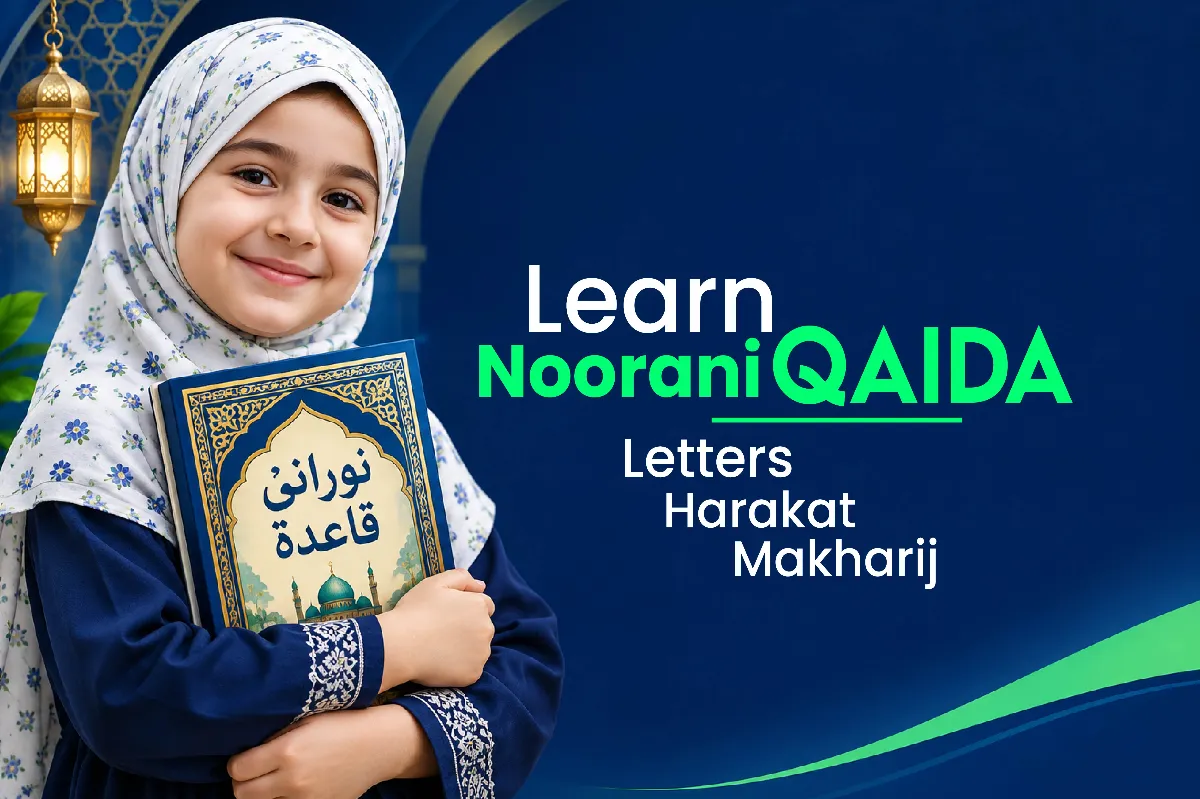
Reading the Quran well starts with a strong base. This guide gives you Noorani Qaida for beginners in plain words. You will see what each lesson teaches and why it comes in that order. We cover the letters, the harakat, and the makharij, which means the place each sound comes from. You will also find a simple plan to begin today, the mistakes to avoid, and answers to ten common questions. If you can read this page, you can follow this path.
Important Things to Know About Noorani Qaida
Keep these points in mind before you open the book.
- Noorani Qaida lessons follow a clear order. Each page uses what you learned on the page before it.
- The book is also called Qaida Noorania. Both names mean the same primer.
- Most editions have 16 or 17 lessons, and the order can change a little from one edition to another.
- You move from single letters to joined letters, then to short vowels, long vowels, and stopping signs.
- Sound cannot be learned from print alone, so you need a teacher or a clear audio guide.
- Short daily practice works better than one long class each week.
- Adults often finish in one to three months. Children may need more time, and that is fine.
Noorani Qaida Lesson by Lesson
Here is the path from the first page to the last. Lesson names can change from one publisher to another, but the flow stays the same. Think of it like building a house. You lay the floor first, then the walls, then the roof.

Noorani Qaida Letters and Joined Forms
Lesson 1: Single letters: The Arabic alphabet has 29 letters. In this lesson you learn the name, shape and sound of each one. Take your time here, because everything else sits on top of it. Some letters look the same and only the dots are different, like ب, ت and ث. Look at the dots every single time, and say the sound out loud.
Lesson 2: Joined letters: In real words, letters join each other. Most letters change shape at the start, in the middle and at the end of a word. A good way to learn this is to write each letter four times. Write it alone, at the start, in the middle, and at the end. Your eyes will soon know each shape on sight.
Lesson 3: Opening letters: Some surahs begin with letters like Alif Laam Meem. You read these by their names, not as a word. This short lesson trains your eyes to spot them and your tongue to say them the right way.
Noorani Qaida Harakat and Marks
Harakat are the small marks that tell you how to say a letter. Without them, a beginner cannot know the sound of a word.
Lesson 4: The three short vowels: Fatha is a small line above a letter and gives a short “a” sound. Kasra is a small line below a letter and gives a short “i” sound. Damma looks like a tiny waw and gives a short “u” sound. Read each letter with all three marks, like ba, bi, bu. Do this with every letter until it feels easy.
Lesson 5: Tanween: Tanween means two marks together. It adds a light “n” sound at the end of a word: an, in, un. Say it softly and do not press on it.
Lesson 6: Standing marks: A standing fatha, a standing kasra and an inverted damma stretch the sound longer. Hold the sound for two counts, then stop.
Lessons 7 and 8: Madd and Leen letters: Alif, waw and ya can stretch a sound when they follow a matching vowel. These are the madd letters. Leen letters are waw and ya with a sukoon after a fatha. They give a soft sound like “aw” and “ay”.
Noorani Qaida Sukoon, Shaddah and Madd
Three signs cause the most mix ups, so go slowly and practise each one by itself.
- Sukoon is a small circle. It means the letter has no vowel, so you rest on it.
- Shaddah looks like a tiny letter w. It means the letter is doubled. The first half rests and the second half moves.
- Madd means stretching. The normal stretch is two counts. Tap your finger twice to keep time.
These three signs are your first step toward the Tajweed rules.
Noorani Qaida Makharij Made Simple
Makharij are the exact places in your mouth and throat where each letter starts. A small change in the place can change the meaning of a word. Arabic has five main areas.
- The empty space (Jawf): the long sounds of alif, waw and ya come from the open space of the mouth and throat.
- The throat (Halq): six letters come from here. They are ء, ه, ع, ح, غ and خ.
- The tongue (Lisan): most letters come from different parts of the tongue.
- The lips (Shafatayn): ba, meem and waw use the lips. Fa uses the top teeth and the lower lip.
- The nose (Khayshum): the nasal sound called ghunnah comes from here.
Some pairs confuse many learners. Try س and ص, ت and ط, ح and ه, and ع and ء. Say each pair slowly in front of a mirror and watch your mouth. A teacher can show you the exact tongue and lip place. A book cannot do that for you.
The last lessons put it all together. You read longer words, then practise noon sakin, tanween, meem sakin and the stopping signs. By then you will be reading short lines of the Quran with care.
Benefits of Noorani Qaida
Here is why Noorani Qaida is worth your time. Learning the primer first pays off in many ways.
- Clear sounds: You stop mixing letters like س and ص, and your words become easy to understand.
- No guessing: You read every vowel mark instead of guessing the sound, so your reading becomes accurate.
- Smooth reading: You stop at fewer words, so your recitation flows like a calm river.
- A strong base for memorizing: Hifz becomes faster when your reading is correct, because you do not repeat old mistakes.
- Right habits from day one: Wrong sounds are hard to fix later, so it is better to learn them correctly now.
- Confidence at any age: Kids and adults both feel proud when they read their first full line without help.
Step by Step Guide to Noorani Qaida
Follow these seven steps. They work for kids and adults.
- Pick a teacher: Live correction matters most. You can learn Noorani Qaida online with a trusted teacher, or join a live class at Quran Janan.
- Set a daily time: Choose 20 to 30 minutes at the same hour each day. A habit is easier to keep than a mood.
- Start with letters: Learn the name, shape and sound of the Arabic alphabet before you touch any vowel.
- Add one skill at a time: Move to the next lesson only after you can read the page three times without a mistake.
- Practise makharij with a mirror: Watch your lips and tongue. Copy your teacher’s sound, then check your mouth.
- Record your voice: Listen to your recording and compare it with your teacher. You will hear small errors that you cannot feel while speaking.
- Revise every week: Go back to old pages on the weekend. Then read a short surah to use what you learned.
Noorani Qaida Summary and Conclusion
Noorani Qaida takes you from single letters to confident reading, one small step at a time. First you learn the letters and how they join. Then the harakat give each letter its sound, and the makharij tell you where that sound is born. Sukoon, shaddah and madd shape the rhythm of your reading. Take it slowly, practise every day, and let a teacher fix your mistakes early. If you want live guidance, Quran Janan can help you take the first step. You can do this, one page at a time.
Frequently Asked Questions About Noorani Qaida
1. What is Noorani Qaida and who is it for?
It is a short primer that teaches you how to read the Quran from zero. It starts with letters and ends with basic Tajweed rules. It is for kids, teens and adults who cannot read Arabic yet, or who want to fix their reading.
2. How many lessons are in Noorani Qaida?
Most editions have 16 or 17 lessons. Some publishers split or join a few pages, so the list can look a little different. The path is always the same: letters, joining, vowels, stretching and stopping signs.
3. What are harakat in simple words?
Harakat are small marks above or below a letter. They tell you which short vowel to say. The three main ones are fatha, kasra and damma.
4. What does makharij mean?
Makharij means the exit points of letters, or the places where sounds start. They are in the throat, the tongue, the lips, the empty space of the mouth and the nose. Correct makharij keeps the meaning of a word safe.
5. How long does it take to finish the Qaida?
Adults often finish in one to three months with regular practice. Children may need more time because they need more repeats. Your daily practice matters more than your age.
6. Can I learn it at home without a teacher?
You can start with a book and audio, but a teacher is a big help. A teacher hears small errors in makharij that you may miss. If you cannot find a class near you, you can learn Quran online with live video lessons.
7. Why learn the Qaida before the Quran?
It builds the base. You learn to read each letter and mark correctly before you face long verses. Mistakes made early are hard to fix later, so a slow start saves time.
8. What is the difference between sukoon and shaddah?
Sukoon is a small circle that means the letter has no vowel, so you rest on it. Shaddah looks like a tiny w and means the letter is doubled. With shaddah you say the letter twice, once resting and once moving.
9. How much should I practise every day?
Aim for 20 to 30 minutes each day. Short and regular sessions work better than one long session. Add a few minutes of revision on the weekend.
10. Can kids and adults both learn it?
Yes. There is no age limit. Kids learn through games and repeats, and adults learn through patterns and steady habits. Start at a calm pace with a kind teacher.


