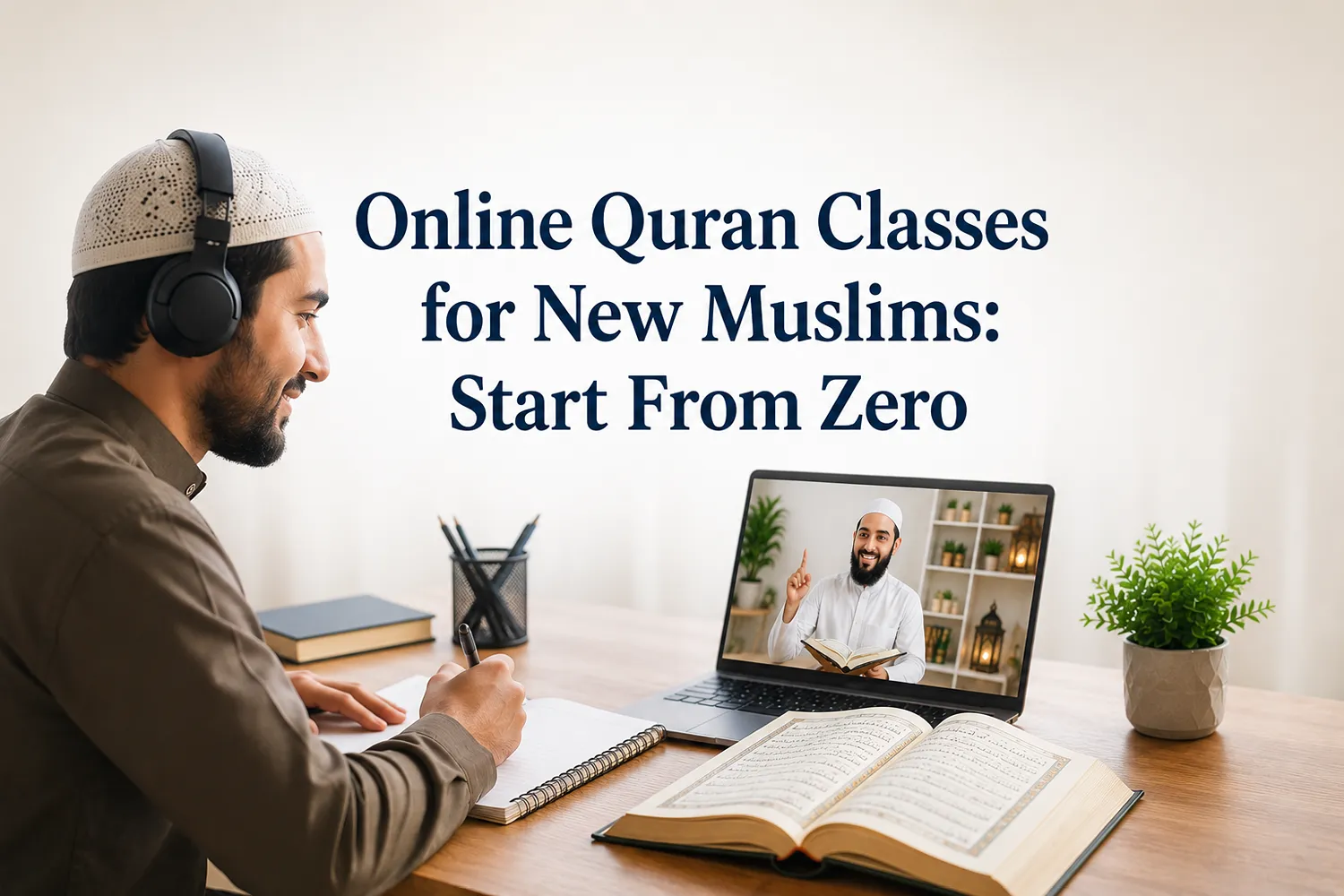
Taking your shahada is the beginning, not the finish line. And for a lot of new Muslims, the very next question is a quiet, slightly nervous one: how do I actually read the Quran when I can’t read a single Arabic letter yet? If that’s you, you’re in the right place. Online Quran classes for new Muslims are built for exactly this moment, starting from the alphabet and moving at your pace with a teacher who has done this many times before. This guide walks you through how these classes work, what your first month looks like, and how to begin without feeling out of place.
What are online Quran classes for new Muslims?
Online Quran classes for new Muslims are one-on-one lessons taught over video call that start with the Arabic alphabet and basic pronunciation, then build toward reading the Quran with correct Tajweed. There is no assumption of prior knowledge. The teacher adapts each session to an adult convert who is learning the script, the sounds, and the meaning together, all from home.
That last part matters more than people expect. You are not dropped into a class with children who have been reading since age four. You get a private lesson, your own pace, and a teacher whose entire job in that half hour is you. Quran Janan runs these sessions the same way for a revert in Toronto as for one in Manchester, over Zoom or Skype, on whatever device you already own.
Why new Muslims often struggle with a normal class
Here is the honest problem. Most Quran programs are quietly designed for people who grew up around the language. The teacher says “sound out the letter” and assumes you already know the letter. Group madrasa settings move at the speed of the fastest child. A new Muslim adult, learning a right-to-left script for the first time while also learning how to pray, gets left behind fast, and the embarrassment of falling behind is often what makes people quit.
One-on-one online learning removes the audience. Nobody hears you stumble over a letter for the tenth time except a teacher who expects it. You can ask “What does this word mean?” without holding up a room. If you want to understand how private lessons compare to a group setup, our breakdown of one-on-one online Quran tutoring covers it in plain terms, and the same logic applies doubly to converts.
Your first month: what actually happens
New students almost always ask the same thing. Not “is this hard” but “will I ever get there?” So here is a realistic map of a beginner’s first four weeks, based on how beginner Quran students at Quran Janan typically progress.
| Week | Focus | What you can do by the end |
| Week 1 | Arabic letters, isolated forms | Recognise and name most of the 28 letters |
| Week 2 | Letter sounds and short vowels (harakat) | Read simple two- and three-letter combinations |
| Week 3 | Joining letters, long vowels | Read short words smoothly |
| Week 4 | First lines of the Quran with the teacher | Read a full ayah slowly, with help |
That pace is not a promise; it is a pattern. Some people move faster, some slower, and that is completely fine. The tool most teachers use for this stage is the Noorani Qaida, a step-by-step primer that teaches the script before you ever open the Quran itself. It exists precisely so absolute beginners have a bridge.
How do I start learning Quran as a new Muslim?
Start with the Arabic alphabet through a structured primer like the Noorani Qaida, taught one-on-one so you can ask anything without embarrassment. Book a free trial, tell the teacher you are a new Muslim starting from zero, and let them place you at the right level. From there, it is short, regular sessions, three to five times a week, that build reading, pronunciation, and confidence together.
The single biggest predictor of success is not talent. It is short and frequent beating long and rare. Two focused sessions of 30 minutes will take you further than one exhausting ninety-minute marathon on a Sunday. Consistency is the whole game.
Do I need to learn Arabic to read the Quran?
Not to read it, no. Reading the Quran means decoding the Arabic script and pronouncing the words correctly, which is a distinct skill from understanding spoken Arabic or holding a conversation. Millions of Muslims worldwide recite the Quran fluently without speaking conversational Arabic. Understanding the meaning is a separate, later journey, usually through translation and tafsir, and a good teacher will point you there when you are ready.
Is it too late to learn as an adult?
It is not too late. Adults often learn to read the Quran faster than young children because they already understand how reading works; they can self-correct, and they are choosing to be there. What adults need is a patient teacher and a private setting, both of which online Quran classes for adults are designed to provide. Age is rarely the obstacle. Feeling watched is.
What you learn, in order
A good program for reverts follows a clear sequence rather than jumping around. The rough order looks like this:
- The Arabic letters and their shapes
- Short vowels and basic sounds
- Joining letters into words
- Reading with fluency (Nazra)
- Correct pronunciation rules, or Tajweed
- Optional: memorising short surahs for prayer
That fifth step, Tajweed, is where recitation goes from readable to beautiful. Tajweed is the set of rules that govern how each letter is pronounced, where sounds are lengthened, and how words connect. You do not need it to begin, but you grow into it. Our guide on how to read Quran with Tajweed for beginners explains the concept gently, and there is a fuller Tajweed learning path for when you are ready to go deeper.
Learning to pray alongside reading
Here is a gap most articles skip. New Muslims usually have two urgent needs at once: reading the Quran, and being able to pray. These overlap, because salah requires reciting Surah Al-Fatiha and a short surah from memory. A teacher who understands converts will often weave the prayer surahs into your reading lessons early, so you can start praying properly within weeks instead of waiting until you finish an entire primer.
If that is your priority, say so in your first lesson. Tell the teacher, “I want to be able to pray correctly as soon as possible.” A flexible program will reshape the plan around that goal. This kind of adjustment is normal in flexible classes built around adult schedules, where the point is your life, not a fixed syllabus.

How much do these classes cost?
Fees vary by teacher, country, and how many sessions you take per week, but online lessons are generally far cheaper than in-person tutoring because there is no travel or overhead. Many academies price by monthly plans rather than per lesson, and most offer a free trial so you can test the fit before paying anything. You can see the general approach on our page for affordable online Quran classes.
A quick, honest comparison of your options:
| Option | Pace for a new Muslim | Privacy | Typical cost |
| Local mosque group class | Fast, not beginner-paced | Low | Free or donation |
| In-person private tutor | Good | High | Higher, plus travel |
| Online one-on-one class | Beginner-paced | High | Lower, no travel |
| Self-study apps | Your own pace | Total | Low, but no feedback |
Apps are fine for revising letters, but they cannot hear your pronunciation and correct it. That live feedback is the difference between reading the Quran and reading it correctly, and it is why a real teacher matters most at the very start.
What to look for in a teacher for reverts
Not every qualified teacher is the right teacher for a new Muslim. Beyond the obvious credentials, look for patience, the ability to explain in your language, and zero judgment about where you are starting. Ask directly whether they have taught converts before. Many teachers at established academies work regularly with new Muslims and reverts, including learners who have never seen Arabic script, and that experience shows in how they pace a lesson.
A few practical checks before you commit:
- The first lesson is free or low cost, so you can test the fit
- Lessons are one-on-one, not group
- The teacher can communicate clearly in English
- You can choose times that suit your timezone
- There is a clear plan, not just random pages
If you want a wider view of choosing well, our Learn Quran online for adults resource and the general Quran Janan academy overview both help you judge quality before you book.
A word on patience and mercy
Learning to read the Quran as a new Muslim is one of the most rewarding things you will do, and also one of the slowest at first. There will be a week where the letters blur, and you feel like you are getting nowhere. That week is normal. It happens to almost everyone, and it passes. The scholarly tradition is clear that the reward is tied to the effort and the struggle, not only to the fluency. For a plain-language explanation of what Tajweed and Quranic recitation actually involve, the Encyclopaedia Britannica entry on the Quran is a reliable, non-partisan starting point.
Keep your sessions short, keep them regular, and let the teacher carry the plan. Your only job is to show up.
Ready to begin?
You do not need to know anything before your first lesson. You do not need to buy anything. You just need to start. Quran Janan offers new Muslims a free trial class with a patient, one-on-one teacher who begins exactly where you are, whether that is the very first letter or a few surahs already learned.
Message us on WhatsApp at +92 333 2515313, or book your free trial through the Quran Janan website, and tell us you are a new Muslim starting out. We will take it from there, one letter at a time.
Frequently Asked Questions
Can I learn the Quran if I only know English?
Yes. Lessons are conducted in English while you learn to read Arabic script. Your teacher explains everything in a language you understand, and you gradually pick up the Arabic letters and sounds. Reading the Quran does not require you to speak conversational Arabic first.
How long does it take a new Muslim to read the Quran?
Most beginners can read simple words within four to six weeks of regular short lessons, and read the Quran slowly with help within a few months. The pace depends on how often you practise. Three to five short sessions a week is far more effective than one long session.
Do I need to memorise anything to start?
No. Reading comes first. Many new Muslims do choose to memorise Surah Al-Fatiha and a few short surahs early so they can pray, and a good teacher will fit this into your reading lessons if you ask.
Are online Quran classes suitable for adults who feel shy?
Very much so. One-on-one online lessons are private, so no one hears you learning except your teacher. This is often the single biggest reason adult converts prefer online classes over group settings at a local mosque.
Is there a free trial for new Muslims?
Yes. Quran Janan offers a free trial lesson so you can meet the teacher, test the platform, and confirm it suits you before committing to any paid plan. Just mention that you are a new Muslim when you book.
What do I need for my first class?
Only a device with a camera, a stable internet connection, and a quiet spot. Your teacher will share the digital materials, including the Noorani Qaida pages, so you do not need to buy books before you start.


